

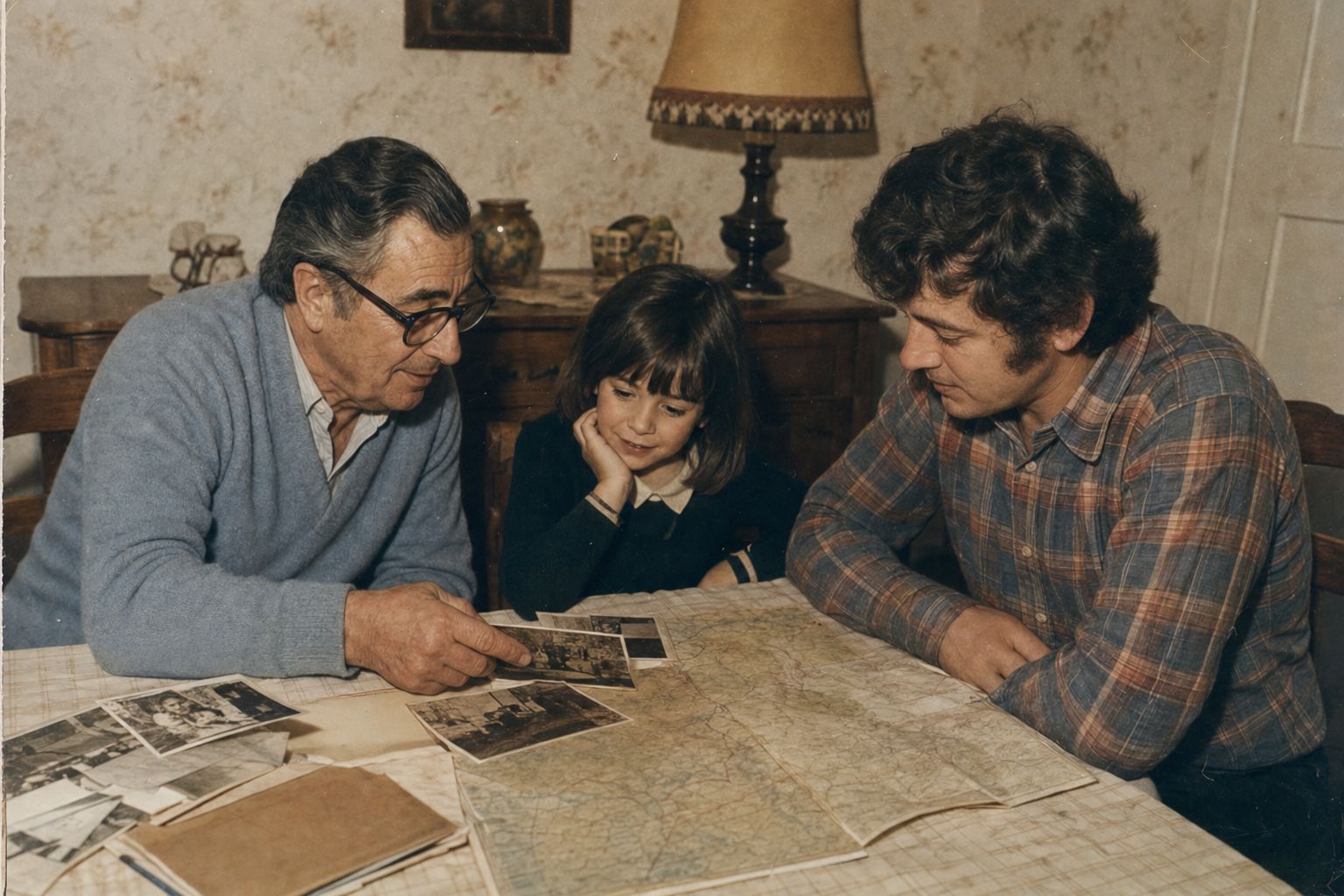
We think we know our history, yet family stories hold surprises for those who truly listen. A conversation reveals an exile, a bankruptcy, a thwarted love, and suddenly a whole part of our past becomes clearer.
We know our birth date, our parents' occupations, a few milestones passed down by habit. The rest sleeps in the memories of elders, in boxes of letters, and in silences.
These stories passed down from generation to generation draw the map we inherit without knowing it. To neglect them is to move forward without bearings. To collect them is to give ourselves roots and, often, explanations.
Family stories tell History on a human scale
Ostensibly, these are small stories: the grandfather who left for the city with a cardboard suitcase, the grandmother who hid coins in a sugar box, the uncle who returned transformed from a long journey. The family brings them out at festive meals, always a little embellished.
Beneath the anecdote, however, History can be read: the rural exodus, wars, economic crises, women's emancipation, migrations. Family stories translate major events on the scale of a house, a village, a kitchen table. They show how a specific family navigated its century.
Understanding one's family past thus means understanding two things at once: where one's people come from, and how the world shaped them.
A key to better understanding our past and our identity
Psychologists and clinical sociology practitioners have long observed it: we inherit far more than just possessions and genes. Invisible loyalties, values, silences, restorative ambitions: each family transmits a family narrative in which everyone, often unknowingly, plays a role.
Bringing these stories to light helps us find our place. A particular career choice extends a line of artisans, a certain prudence with money dates back to an ancient ruin, a certain importance given to studies makes up for an interrupted education. Understanding these threads brings greater freedom: one can then choose what to keep and what to transform.
To tell one's family story is a bit like reading oneself in a long version, with chapters that precede one's own birth and often explain what follows.
Stories of resilience that serve as benchmarks
Family stories also have a very concrete virtue: they provide examples. Psychological researchers have highlighted that children who know their family's history, its successes and its trials, navigate difficulties better. Knowing that their own people overcame wars, bereavements, and new beginnings helps put their own storms into perspective.
The most useful story is rarely the most glorious. A bankruptcy overcome, a divorce navigated, a departure into the unknown teach more than flawless successes. These stories tell the younger ones: we bent, we held on, you will hold on too.
That's what giving roots means: offering precedents to those who doubt.
Collecting the words of elders before they fade
This memory has guardians, and they are aging. Each loss carries away answers that no one thought to ask. Genealogists reiterate: archives provide dates, only witnesses give meaning.
Collecting the stories of one's parents or grandparents requires few resources: time, open-ended questions, patient listening. Photographs, letters, and objects awaken dormant memories. A simple phone is enough to record a voice.
Short, regular meetings are better than a long, solemn session: memory awakens gradually, and the best stories often come during the third or fourth conversation, once trust has been established.
It is also important to approach sensitive areas with delicacy. Some silences protect wounds; words come when trust is present, sometimes after several conversations. The goal remains transmission, never interrogation.
Shaping these stories so they can travel
A conversation moves, a text endures. For these stories to reach future generations, they must be written down: in a notebook, assembled loose-leaf pages, or even better, a true family book that everyone can open thirty years from now.
This is where we come in at Elefantia: our application transforms speech into a structured narrative, chapter by chapter, and our biographers accompany those who prefer to work with someone, right up to the printed book. The essential thing, however, remains the initial act: to initiate the conversation while there is still time.
A life story put into written form ceases to depend on a single memory. It becomes a common heritage, accessible to all who bear the name.
Writing today the memories that others will need tomorrow
We are all links in a chain. The stories we collect illuminate our past; the ones we write will illuminate the past of our descendants, because our present will become their history.
Writing your own biography, recording the history of your parents, even modestly noting the significant episodes of the family: these are all actions that seem small today but which, in fifty years, will be treasures.
A family that tells its story understands itself better, transmits itself better, and stays closer. Family stories form the part of the inheritance that is never divided by a notary, and it is perhaps the most precious.

Share:
Digital heritage: preserving the voices of our elders
Tribute to a deceased loved one: writing their life story