

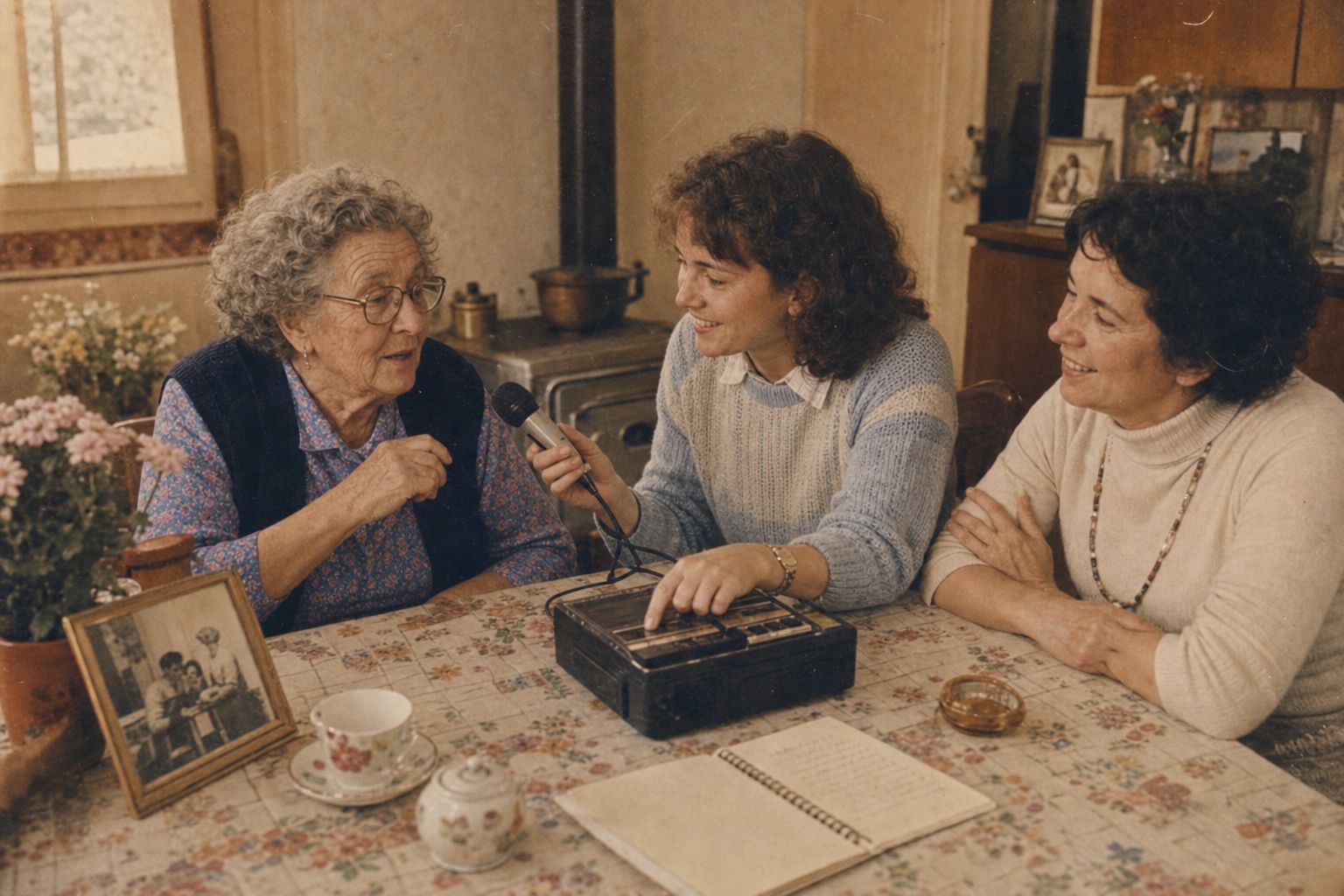
Seniors are said to be digitally challenged. Screens too small, incomprehensible menus, forgotten passwords: the list of grievances is well known, and it feeds a persistent misconception. Yet, the relationship between seniors and technology is profoundly changing, particularly in an unexpected area: the transmission of life stories.
The desire to tell stories has always been there. Elders have stories in abundance and the desire to share them with their children and grandchildren. All that remained was to invent tools tailored to them. This has now been done, and it changes a lot of things for families.
A generation less disconnected than we think
The stereotype of the technophobic senior does not stand up well to observation. Today's grandparents use video conferencing to watch their grandchildren grow up, exchange photos on family messaging apps, listen to the radio on tablets, and check the weather before going to the market.
Gerontologists who study digital usage among older people make an illuminating observation: seniors readily adopt technology when it serves a need that truly matters to them, especially connecting with loved ones. The difficulty rarely comes from age itself; it comes from tools designed without them in mind.
In other words, when a technology fails with seniors, it is most often the design that needs to be questioned, rather than the users. Designers have understood this, and a new generation of tools is emerging: simpler, more readable, designed to support rather than to impress. The transmission of life stories perfectly illustrates this movement.
Telling your life story used to be an uphill battle
Take the case of life stories. Twenty years ago, a senior who wanted to transmit their story had few options. Writing hundreds of pages alone, over a long period, with the fear of "writing badly." Hiring a professional biographer, a valuable process whose cost remained out of reach for many families. Or giving up, convincing themselves that their memories would not interest anyone.
The result: countless family stories were never recorded. Childhoods in the countryside, lost professions, exiles, reconstructions - a whole heritage of memory vanished due to the lack of a simple way to collect it.
This is exactly the kind of barrier that innovation, when well-employed, knows how to break down.
When technology adapts to seniors, voices are freed
The great evolution of recent years can be summed up in one word: voice. Recent tools allow people to tell their stories by speaking, simply, as in a conversation. No more hours spent on a keyboard or complex software to tame: you answer questions, you evoke a memory, and the technology takes care of collecting the words, organizing them, and formatting them.
At Elefantia, we built our application around this principle. Questions guide the recollection, the person speaks or writes according to their preference, and the story gradually takes shape, chapter after chapter. Those who wish for human presence can be accompanied by our biographers, the Elefantos, right up to the printed book.
What matters in this approach is the effacement of technology. The person has only one thing to do: tell their story. And seniors are admirably good at telling stories, always have been.
The pace also belongs to everyone. Five minutes one morning, an hour on a rainy Sunday: the story progresses in touches, without obligation or deadline. This flexibility is particularly suitable for seniors, who can follow their energy and their current desires. Many also discover that memories continue to surface between sessions, as if memory, once stimulated, continues the work on its own.
Technology becomes a bridge between generations
An unexpected effect deserves to be highlighted: these tools bring generations together instead of separating them. Around a life story project, roles are nicely distributed. The grandson installs the application and starts the recording; the grandmother, on the other hand, holds the content, the stories, the precious material that no one else possesses.
Each brings what the other does not have. Memories circulate, questions fly, and the "technology" session transforms into an afternoon of transmission. Many families discover episodes on this occasion that no one had ever told: a first love, an improbable journey, a decision that changed everyone's destiny.
Family memory gains a lasting support, and the relationship gains moments that are among the most precious. Psychologists specializing in aging also emphasize this: feeling listened to and questioned about one's life nourishes seniors' self-esteem and restores their central place in the family circle. Transmitting, at this age, means feeling useful, awaited, recognized.
The desire to tell stories matters more than mastering tools
One frequent question from families remains: how do you get a parent who has never touched a tablet to start? The answer often lies in a first shared moment. You sit together, choose an easy question, record a first anecdote, and apprehension disappears in a few minutes. Technology is tamed all the better when it immediately serves something loved.
It must be reiterated to hesitant seniors: no particular digital skill is required to transmit one's story. Knowing how to evoke a memory aloud is largely sufficient, and the support, human or application-based, takes care of the rest. Starting small is also enough: one memory told this week, another the following week, and the story progresses effortlessly.
Innovation has simply put things back in the right order: technology serving speech, tools serving connection. The stories of a generation can now traverse time, printed in a book that children and grandchildren will open long after, with the emotion of finding a familiar voice between the lines.
And you, who do you think of when you read these lines? A parent, a grandmother, an uncle with an inexhaustible repertoire of anecdotes? The next visit might be an opportunity to simply suggest that they start telling their story. You might be surprised at the joy with which they accept.

Share:
Writing Your Biography: An Exercise in Well-being
Elefantia, the app for preserving your family heritage