

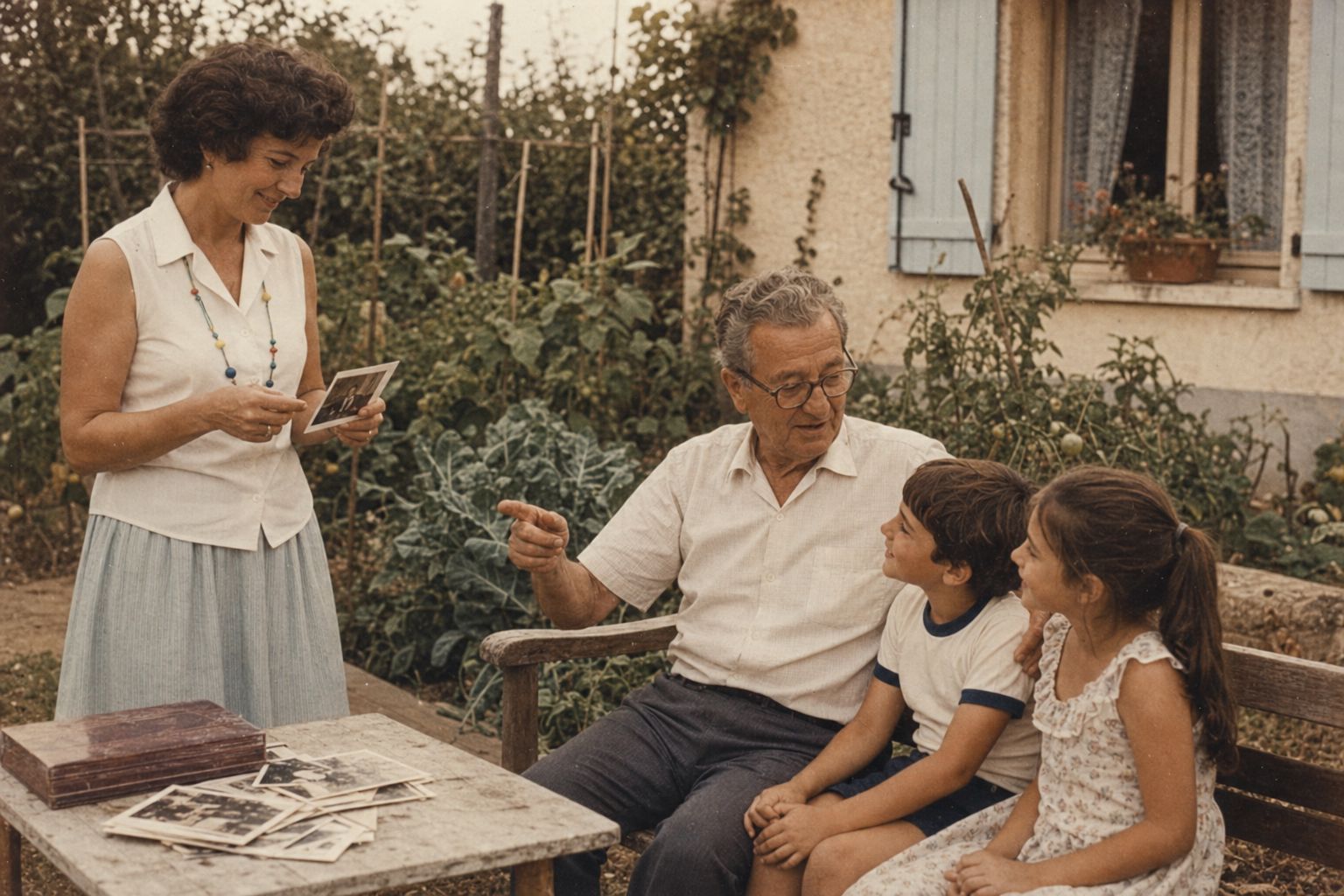
One Sunday afternoon, a teenager asks her grandfather how he met her grandmother. Two hours later, the cake has cooled, no one has checked their phone, and the family table has become the setting for a story no one truly knew. Building connections across generations through memories often begins this way, with a simple question asked at the right moment.
Many families have experienced this scene at least once. It conveys an essential truth: a single well-told story brings a grandparent and grandchild closer more effectively than months of polite messages and hurried visits.
However, these moments must be prompted, welcomed, and, if possible, preserved. For these stories, precious above all others, are also the most fragile.
Two worlds that cross paths without always meeting
Grandparents and grandchildren sometimes live just a few miles apart, yet in distinct universes. The former experienced evening gatherings, school certificates, and letters awaited for weeks. The latter grow up with screens, instant messaging, and memory externalized in the cloud.
Family sociologists observe bonds stretched by geographic mobility and the accelerating pace of life. Opportunities to see each other exist—birthdays, holidays, vacations—but they are filled with activities rather than conversations. People greet each other, embrace, and exchange news. They rarely tell stories to each other.
Shared memory precisely fills this void. It creates common ground where daily life no longer offers it.
Memory, a bridge between generations
Why does a life story bring people so close? Because it transforms the relationship. As long as the grandparent remains "grandpa" or "grandma," they fulfill a role. As soon as they recount their twenties, their fears, their daring deeds, they become a complete person, with a youth, doubts, loves, and struggles.
For the child or teenager, the discovery is striking: this discreet gentleman emigrated alone at seventeen, this reserved lady ran a business for forty years. The past ceases to be an abstract history lesson and takes on a familiar face.
Developmental psychologists have often stressed that children who know their family history have stronger identity markers. Knowing where you come from helps you understand who you are, and provides concrete examples of difficulties overcome.
"Tell me what it was like" remains one of the most beautiful proofs of attention a grandchild can give.
What storytelling also brings to our elders
The benefit flows both ways. In gerontology, the function of reminiscence is well known: recalling memories helps older people re-examine their journey, giving it coherence and meaning. To tell one's story is to bring order to one's life and realize that it forms a story worth hearing.
It is also about regaining a valued social role. In a fast-paced society, many seniors feel they have become spectators. Facing a grandchild who listens, they become transmitters again, custodians of useful experience. Feeling listened to means feeling recognized, and this recognition nurtures self-esteem much more enduringly than any distraction.
How to spark these precious conversations
These moments of transmission are prepared rather than decreed. A precise question is better than an overly broad invitation: "Tell me about your youth" paralyzes, while "What was school like in your village?" opens a door. Objects also make excellent triggers: a yellowed photo, a recipe, a tool, an old song.
The setting is as important as the question. A walk, a car ride, a kitchen where a meal is being prepared liberate speech better than a solemn face-to-face. You must then accept detours: memory progresses by associations rather than chronology, and the seemingly trivial anecdote often leads to the essential memory.
Above all, listen without correcting or rushing. Silence often signals a memory still searching for its words.
From told memories to written family history
One question remains: what happens to these stories once the conversation is over? Oral memory is both moving and fragile. Details fade, voices fall silent, and every family knows this regret: "We should have made him tell us all that."
Writing your biography, or helping a loved one compose their life story, extends these conversations and protects them from oblivion. This is the essence of our work at Elefantia: to enable everyone, alone or with the help of a biographer, to transform their memories into a book that the family can read, re-read, and pass down. Questions guide the narrative, and the story is built at each person's pace, without pressure.
The book then becomes an object of connection in its own right: it is given as a gift, discussed, and reveals episodes never told aloud.
A chain to which everyone can add a link
Building connections across generations ultimately requires little: a sincere question, time, genuine attention. Everyone can start with the next visit, with a rediscovered photograph or simple curiosity.
The chain, moreover, never stops with grandparents. Your children will one day ask the same questions about your own youth. What you gather today, what you write tomorrow, will form the family heritage for those yet to be born.
Generations pass, stories remain. But there still needs to be someone to ask for them, and someone to tell them.

Share:
Dictating your life story: freeing your voice without writing
Writing Your Biography: An Exercise in Well-being