

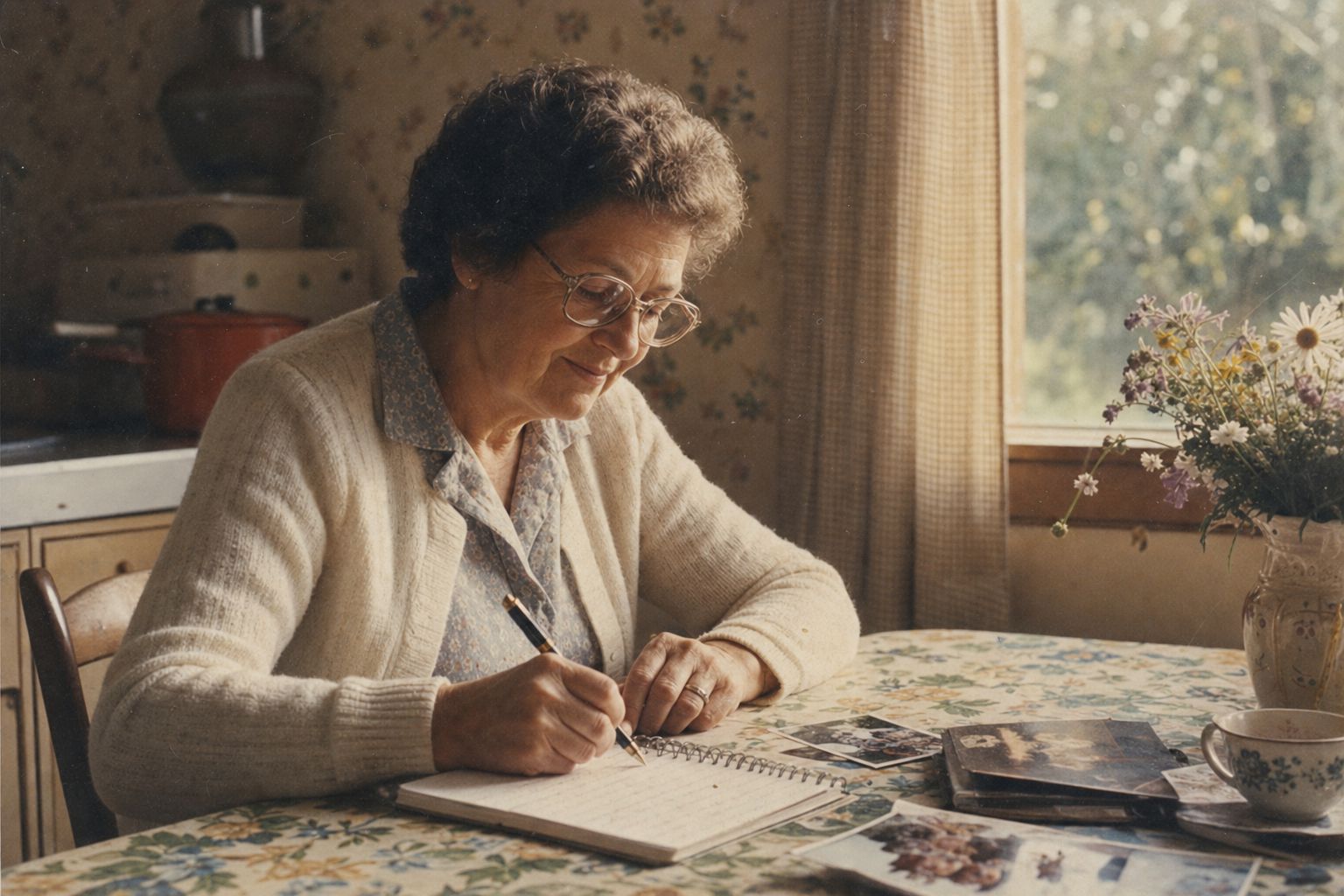
Writing your own story, a narcissistic act? This objection often comes up, and it deserves a real answer. Because writing one's biography is now recognized as a well-being exercise in its own right, studied by psychologists, practiced in life story workshops, and recommended to people going through a transition.
Telling your story, far from contemplating yourself, is about taking stock, giving meaning, and reconciling with entire chapters of your existence. And the benefits are tangible, for both the mind and the heart.
Let's take a closer look at what happens when you set out to write your life story.
Why writing your biography soothes and does good
Psychology has seriously looked into the matter. James Pennebaker's work on expressive writing has shown that putting experiences, even difficult ones, into words improves the well-being of many people. Writing helps to organize what is burdensome, to gain perspective, and to loosen the grip of rumination.
The life story adds an additional dimension: continuity. By connecting childhood, youthful choices, trials, and successes, one reconstructs the thread of an existence. Events cease to be scattered fragments; they become chapters of a coherent story, with its strong points and turning points.
This coherence provides a sense of calm that many describe with the same words: "things fell into place."
Telling your story means recognizing the value of your journey
Many of us minimize what we have experienced. "My life is nothing extraordinary," we hear from almost everyone who hesitates to start. Then the writing begins, and the perspective changes.
Putting your journey down on paper forces you to measure the path: the difficulties overcome, the courageous decisions, the people helped, the courses held in the storm. What one traversed with bowed head suddenly appears for what it was, a sum of efforts, fidelities, and small victories.
Psychologists speak of self-esteem; we could speak more simply of personal recognition. Finally granting oneself the status of the main character in one's own story, with one's strengths and weaknesses, is a form of justice towards oneself.
A powerful memory exercise, especially valuable with age
Writing your biography mobilizes memory like few activities can. Finding the name of a teacher, the smell of a kitchen, the route to school, the year of a move: this effort of evocation deeply engages the circuits of memory.
Gerontologists are familiar with this practice under the name of reminiscence, highlighted by the American psychiatrist Robert Butler. Used with elderly people, the structured evocation of the past stimulates cognitive functions, boosts morale, and strengthens the sense of identity.
Each writing session thus becomes a gentle exercise for the mind. And it frequently happens that one memory recalls another, then ten others, as if memory, kindly solicited, reopened entire rooms that one thought were locked away. This pleasure of rediscovery is also among the most cited reasons by those who embark on this journey: one believes they are starting a demanding task, but discovers a joyful exploration.
Giving meaning to your story, including the difficult pages
Every life involves trials, regrets, and forced detours. Biographical writing allows you to revisit them with the distance of years, and often to understand them differently.
Such a professional failure, re-read twenty years later, reveals that it opened up a better path. Such a breakup, so painful at the time, takes its place in a whole that eventually found its balance. Narration offers this rare privilege: choosing the light in which one views one's past, and extracting lessons for the path ahead.
Clinical sociologists who practice life story telling regularly observe this: telling your story helps you appropriate it, instead of silently enduring it.
Write for yourself, transmit to your loved ones
The beauty of the exercise perhaps lies in its double effect. You first write for yourself, for the well-being and clarity it provides. And you discover along the way that you are also writing for your loved ones.
A biography becomes a gift for children and grandchildren: direct access to who you were before them, at twenty, your struggles, your joys. Family transmission gains a lasting medium, much more vibrant than a silent photo album that no one knows how to caption anymore.
If writing intimidates you, know that there are ways. At Elefantia, you tell your story orally, guided by questions, alone with the app or accompanied by a biographer, up to the printed book. The process remains yours, and so do the words.
The first chapter begins with a simple memory
There's no need to wait for a peaceful retirement, literary talent, or old age. Writing your biography can start today, with a specific memory: a childhood home, a meeting, a first job, a summer that changed everything.
From this fragment will emerge a chapter, then another, and one day, a book. Along the way, you will have sorted things out, measured the journey, rediscovered loved faces, and given your memory a salutary exercise.
So, what moment of your life would you start with? The one that comes to mind right now is probably the right one.

Share:
Family Memories: Building Bridges Between Generations
Seniors and technology: sharing your stories simply