

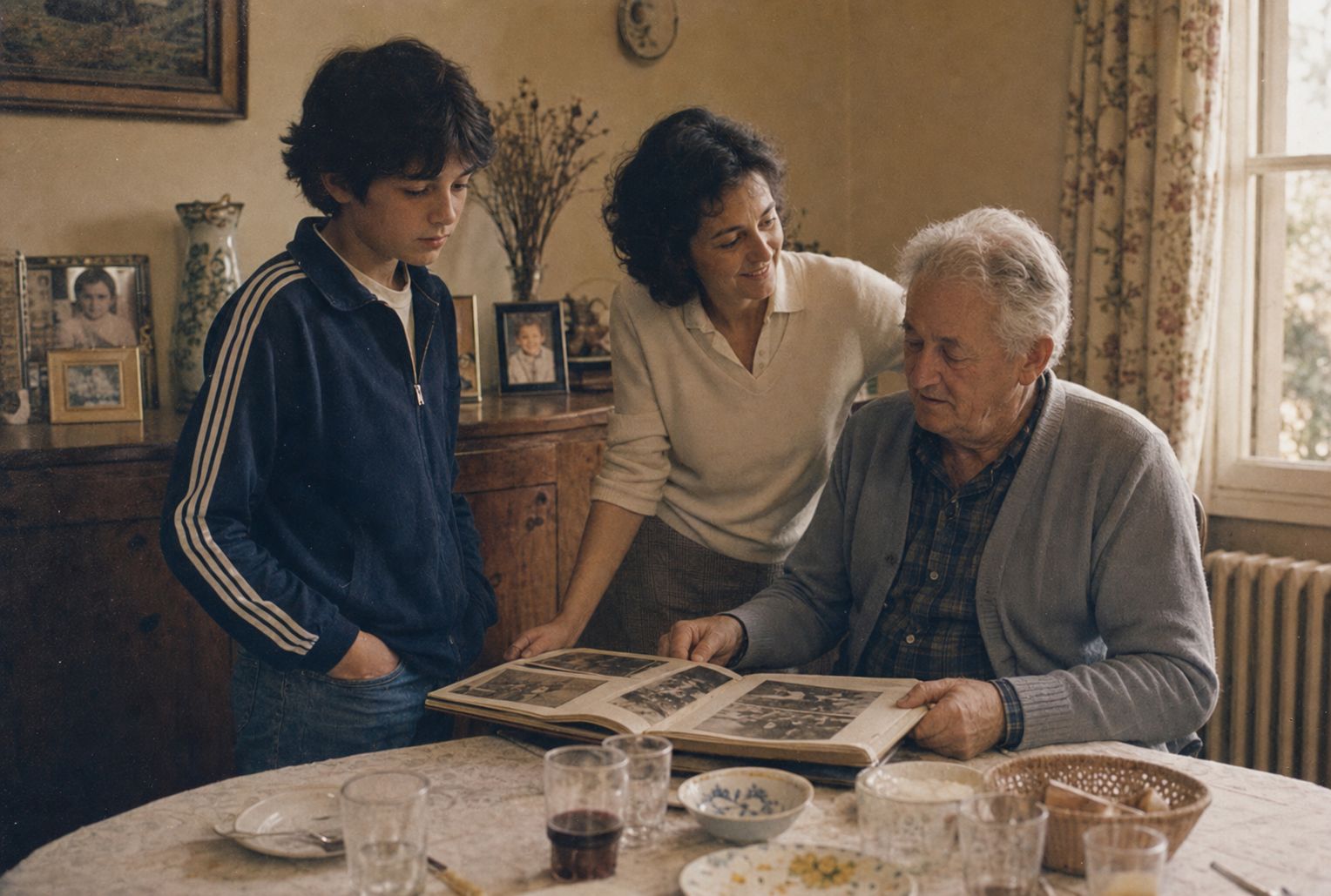
There was a time when family stories were passed down without anyone giving it a second thought. Generations lived under the same roof or in the same village, vigils lasted, and stories circulated with soup and bread. Memory was passed from mouth to mouth, carried by the simple repetition of daily life.
That world has changed. Intergenerational transmission now faces unprecedented challenges: dispersed families, saturated lifestyles, and generations growing up in distant cultural universes. The memories of our elders still exist; it is the opportunities to share them that are becoming scarcer.
Understanding these obstacles is already the first step to overcoming them. Because the good news deserves to be stated right away: never have we had so many ways to preserve our stories, provided we decide to do so.
Distance and Time: The Primary Obstacles to Intergenerational Transmission
The first challenge lies in the geography of contemporary families. Studies lead to one city, careers to another, and grandparents often remain hundreds of kilometers away. Meetings are concentrated on a few holidays a year, joyful but busy moments, where logistics and children are managed more than the stories of yesteryear are listened to.
Then there's the question of time. Transmission requires slowness: a life story is told through digressions, repetitions, and details that call for other details. Our schedules leave little room for this undirected conversation, which is nevertheless the only one where deep memories are willing to surface.
The result is evident in many families: we know about everyone's current events, holidays, health, and work, but almost nothing about the past. Grandchildren adore their grandparents without knowing what they experienced before becoming grandparents.
Generations That No Longer Share the Same Codes
The second challenge is cultural. Between a person born in the 1940s and a teenager born with a smartphone, almost everything differs: the relationship with time, images, speech, and modesty. Elders grew up in a culture where people spoke little about themselves, where hardships were endured in silence. Young people live in a culture of constant, but fragmented, rapid expression, focused on the present moment.
This disconnect creates symmetrical misunderstandings. Elders think their stories are of no interest to anyone, and they remain silent. Young people don't imagine the richness of what their grandparents could tell, and they don't ask. Each waits for a sign from the other, and the window slowly closes.
We must also add the modesty inherent in difficult memories. Wars, exiles, poverty, early bereavements: many elders chose to protect their descendants through silence. This respectable silence, however, deprives subsequent generations of essential keys to understanding their own family.
What is Lost When the Chain of Memories Breaks
One might consider all this regrettable but secondary. That would be to forget what transmission truly brings. Family stories give younger generations a sense of identity: knowing where one comes from, what paths led to oneself, anchors existence in a reassuring continuity. Family psychologists observe that this knowledge nourishes children's confidence and resilience.
The breakdown of transmission also impoverishes elders. An elderly person who is never asked about their life eventually believes that their life no longer matters. Conversely, gerontology highlights the benefits of reminiscence: telling one's past maintains a sense of identity, memory, and morale. Listening to an elder is also taking care of them.
Finally, every lost story amputates collective memory. The gestures of a vanished trade, the life of a neighborhood before renovations, the intimate experience of the century's great events: all this survives only if someone tells it and if someone writes it down.
Recreating the Conditions for Sharing, One Step at a Time
Faced with these challenges, solutions start small. Establish a ritual, for example: a weekly call where a real question about the past is asked, a visit where photo albums are brought out, a recording made during the holidays. Children can be wonderful catalysts; a naive question from a grandchild opens doors that adults no longer dared to push.
Technology, often accused of distancing generations, can here bring them closer. Videoconferences abolish distance, voice messages collect spontaneous anecdotes, and dedicated tools make it possible to structure all this into a true life story. This is the path we propose with Elefantia: an application where the elder answers, orally or in writing, questions that guide their memory, with the discreet help of artificial intelligence or a biographer, leading to a printed book that the family will pass down.
Writing plays a decisive role here. Spoken words evaporate with the years; the book remains, ready to be discovered by a great-grandchild who will only know their ancestor through these pages. Writing one's biography, or helping a loved one to do so, is like building a bridge over time.
Transmission Never Dies, It Waits to Be Revived
It would be wrong to think the battle is lost. The success of genealogical research, the enthusiasm for family archives, the emotion that grips everyone in front of an old letter: everything indicates that the need for roots remains intact. Younger generations want to know; they simply don't realize how urgent it is to ask.
So, let's take this challenge for what it is: an invitation. Every family holds a treasure trove of memories that only needs a little attention to be passed on. A question asked this Sunday, a story noted tonight, a book project launched this year, and the chain continues for another generation.
The biggest challenge of intergenerational transmission may boil down to one sentence: falsely believing that there will always be time. Since you are reading these lines, the right time has probably come to pick up your phone and ask someone you love: "Tell me what it was like, before."
Share:
Collecting memories from the pre-digital generation
Life Story: Reconciling with Your Past