

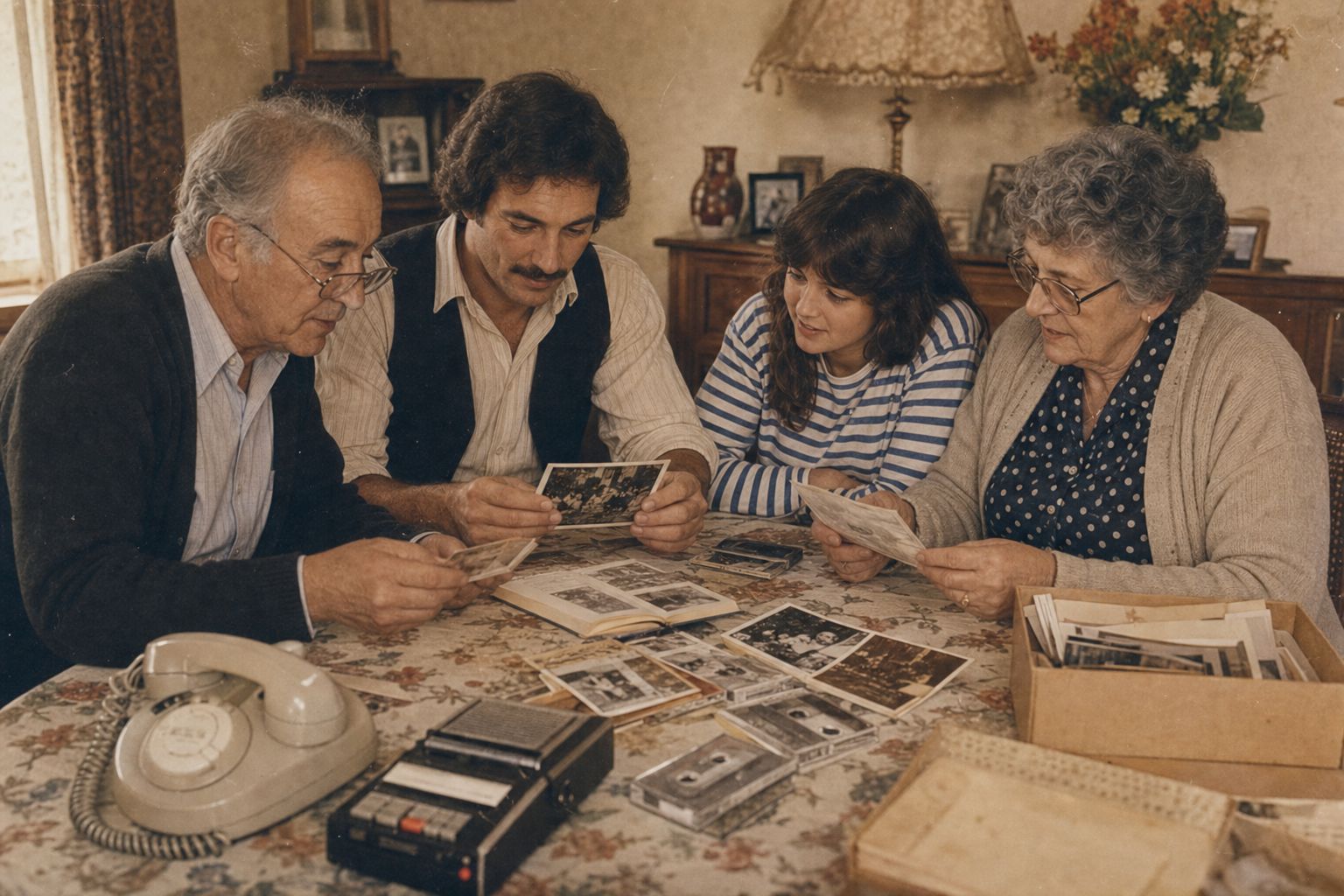
"Ask your grandmother, she'll tell you." How many times have we uttered that phrase, postponing the conversation until later? The memories of a pre-digital generation rely almost entirely on the words of those who still carry them. No social media has captured them, no server stores them, no automatic backup watches over them.
Our elders have lived through entire decades without screens. Their joys, their trials, their vanished trades, their transformed villages live in their memory and almost nowhere else. The writer Amadou Hampâté Bâ put it forcefully: when an old person dies, it's a library that burns.
The good news is that there's still time. Collecting these life stories today takes less effort than one might think and permanently transforms a family.
A living memory that was never recorded
We are living in a unique historical situation. Generations born with the internet leave behind a dizzying amount of traces: photos, videos, messages, publications. Those who grew up before the digital age, conversely, recorded almost nothing of their daily lives.
A few albums with cardboard pages, sometimes letters kept in a box, more rarely a home movie. The setting is there, frozen on paper. The essentials, however, are still missing: the voices, the anecdotes, the emotions, the context. Who is that woman in the second row of the wedding photo? Why did the family leave their region? What did that young man feel when he left to work in the city?
These answers still exist. They lie dormant in the memory of direct witnesses who, very often, are simply waiting to be asked.
The memories of the pre-digital generation tell of a vanished world
Think of all that this generation has seen. Wars and reconstructions, the arrival of running water then television, emptying countryside, factories opening then closing, ways of loving, working and raising children that have profoundly changed.
These experiences are much more than tender anecdotes. They constitute a social memory, a first-hand account of a world that history books summarize in a few lines. Historians and sociologists know it well: ordinary life stories illuminate an era as much as major events.
For a family, these memories have an added value. They explain where we come from, why we bear a certain first name, how certain values were passed down. Psychologists who study intergenerational transmission observe that children who know their family history develop a stronger sense of belonging.
Oral transmission needs a written relay
For centuries, memory was transmitted by word of mouth, by the fireside, around the Sunday table. This oral chain worked because generations lived together, or very close to each other.
Our contemporary lives have stretched this thread. Families are dispersed, visits are shorter, conversations are competed by a thousand solicitations. A memory told once, on a festive evening, fades quickly if it has not been collected. And everyone knows how oral memory distorts, simplifies, forgets.
Writing offers these memories permanence. A life story put down on paper can be reread in twenty years, fifty years, a century. It travels through moves and generations. It patiently awaits the grandchild who, one day, will want to know where they come from. Writing one's biography, or collecting that of a parent, is to offer this lasting relay to the family chain.
Collecting a life story, a simpler gesture than one might imagine
Many give up before even starting, convinced that they need to know how to write, have long weeks available, or undertake costly procedures. The reality is gentler. A life story begins with a conversation.
Ask a precise question rather than an immense one. "Tell me about your first day of school" opens many more doors than "Tell me about your life." Gerontologists use the term reminiscence to describe this work of evoking the past: it stimulates memory, provides pleasure, and strengthens the sense of identity in older people.
It is precisely to facilitate this process that we designed Elefantia. The person recounts, orally, guided by questions; the application structures the collected material, and biographers accompany those who wish until the printed book. Technology fades behind the spoken word, and the story remains that of the person telling it.
Every memory saved becomes a gift for future generations
It must be said simply: we are the last generation that can collect these testimonies firsthand. Every passing month takes away stories that no one will ever hear again.
This urgency is not sad, deep down. It invites moments of rare quality: an afternoon listening to a father recount his twenties, a grandmother who, by speaking, rediscovers details she thought lost. Those who have experienced these conversations speak of them as an unexpected rapprochement, almost a second encounter with a loved one they thought they knew by heart.
And the book that results becomes a unique object of transmission, placed in the family library, open to growing children and those who will come after them. So, what memory of a loved one would you like to save first? The best answer begins with a question asked this weekend.
Share:
Writing to heal: the power of words in the face of grief
Intergenerational transfer: today's challenges