

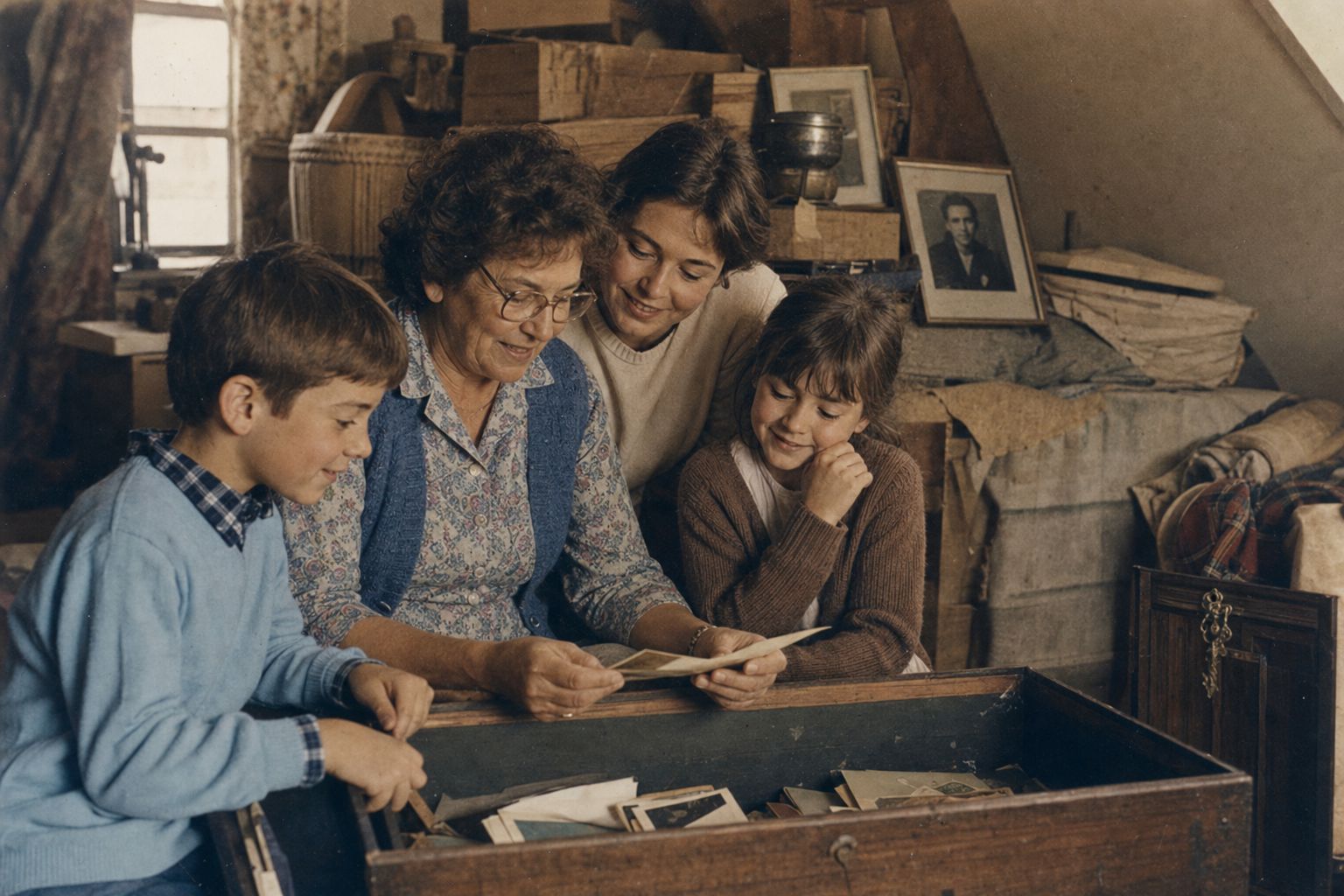
A family lunch on a Sunday. Over coffee, your father suddenly brings up his first job, or the night the whole village came together to put out a fire. Around the table, conversations stop. Even the teenagers look up from their phones. Then someone clears the table, and the story returns to silence.
The memories of our elders are a fragile treasure: every family has them, few take the time to preserve them. How many stories have died out without ever being told, for lack of a timely question?
Yet, collecting these life stories is one of the simplest and most precious gestures a family can make. Here's why and how to do it.
Every family holds memories just waiting to be collected
Our elders have lived through worlds that have now disappeared. They knew school with inkwells and blackboards, trades whose techniques have been lost, homes without telephones, journeys that lasted for days. Their memories are fragments of our collective history: rural exodus, wars, migrations, major changes in work and family life.
These stories also illuminate our own history. Understanding the origins of a family's choices, values, and sometimes silences helps everyone better understand who they are. Family memory functions like a map: without it, you still move forward, but you don't know where you come from or why the path took that route.
An entire life rarely fits into photo albums. Images capture faces and settings; they don't convey voices, emotions, or the decisions that changed everything.
Why do we always postpone these conversations?
"I'll ask questions one day." We've all said this to ourselves. Daily life rushes on, visits are short, and asking a parent about their youth always seems possible next time. There's also a certain reserve, the fear of rekindling pain, or the idea that a big occasion would be needed to broach such topics.
Time, alas, sometimes decides for us. Memory can decline before the body, details fade, names slip away. "One day" then turns into "too late," and this regret lingers long with those who remain.
The good news is simple: starting only takes a conversation. A single sincere question, asked this weekend, is often enough to unlock decades of memories.
Telling one's life story also benefits the one remembering
Collecting memories is often presented as a service to the younger generation. Gerontology shows that it primarily benefits the elders themselves. The work of reminiscence, this organized reflection on one's own existence, strengthens the sense of identity and continuity, rekindles the desire to transmit, and validates an experience that society often overlooks.
Being listened to, truly listened to, is a form of recognition. For many seniors, telling their life story allows them to remain an active part of the family, to still serve something great: to provide roots.
Aged care professionals know this well, as they use reminiscence workshops to stimulate memory and combat isolation. What institutions organize, families can offer even more simply, with attention and time.
The memories of our elders strengthen intergenerational bonds
When a grandparent tells a story and a grandchild listens, something rare happens: two generations that seem separated by everything discover common ground. The teenager learns that their grandmother was once twenty, with dreams, daring acts, and sorrows. Perspectives change on both sides.
Family psychologists regularly observe this: family narratives give young people benchmarks and a sense of belonging. Knowing where you come from helps you navigate your own storms. A story told becomes a common reference, a phrase repeated, a bond that survives distances.
Transmission works both ways, moreover. By asking questions, young people show elders that their lives matter, and this curiosity is worth all declarations of affection.
How to practically collect these life stories
The simplest approach is to start with something concrete: a photograph, an object, a house, a recipe. "Tell me about that day" opens more doors than "tell me about your life." Then, one must listen without correcting, accept digressions, and note or record the voice, because words fly away quickly.
Then comes the question of a lasting trace. This is where a writing project takes over from conversation. With Elefantia, we wanted to make this transition accessible to everyone: the elder tells their story, at their own pace, alone or with the help of a loved one or one of our biographers, and their memories gradually take the form of a real life story book, printed and shared with the whole family.
The tool is less important than the approach. The essential thing remains the desire to create a bond, to ask questions now, and to give the answers a form that will endure through the years.
A legacy worth more than all material possessions
We pass on houses, furniture, some jewelry. These inheritances are shared, sold, damaged. A life story transmits something else: meaning, voice, experience, that invisible thread connecting generations.
In twenty years, your family's most precious possession might be that book where your mother recounts her childhood, where your grandfather finally explains his big departure. A treasure, in the most exact sense of the term, that no one else in the world could have created.
So simply ask yourself this question: what story from your elders would you like to hear one more time, and above all, preserve forever? The answer will tell you where to begin.

Share:
Le Témoignage de Georges Torrese
Write a book without being a writer: tell your story