

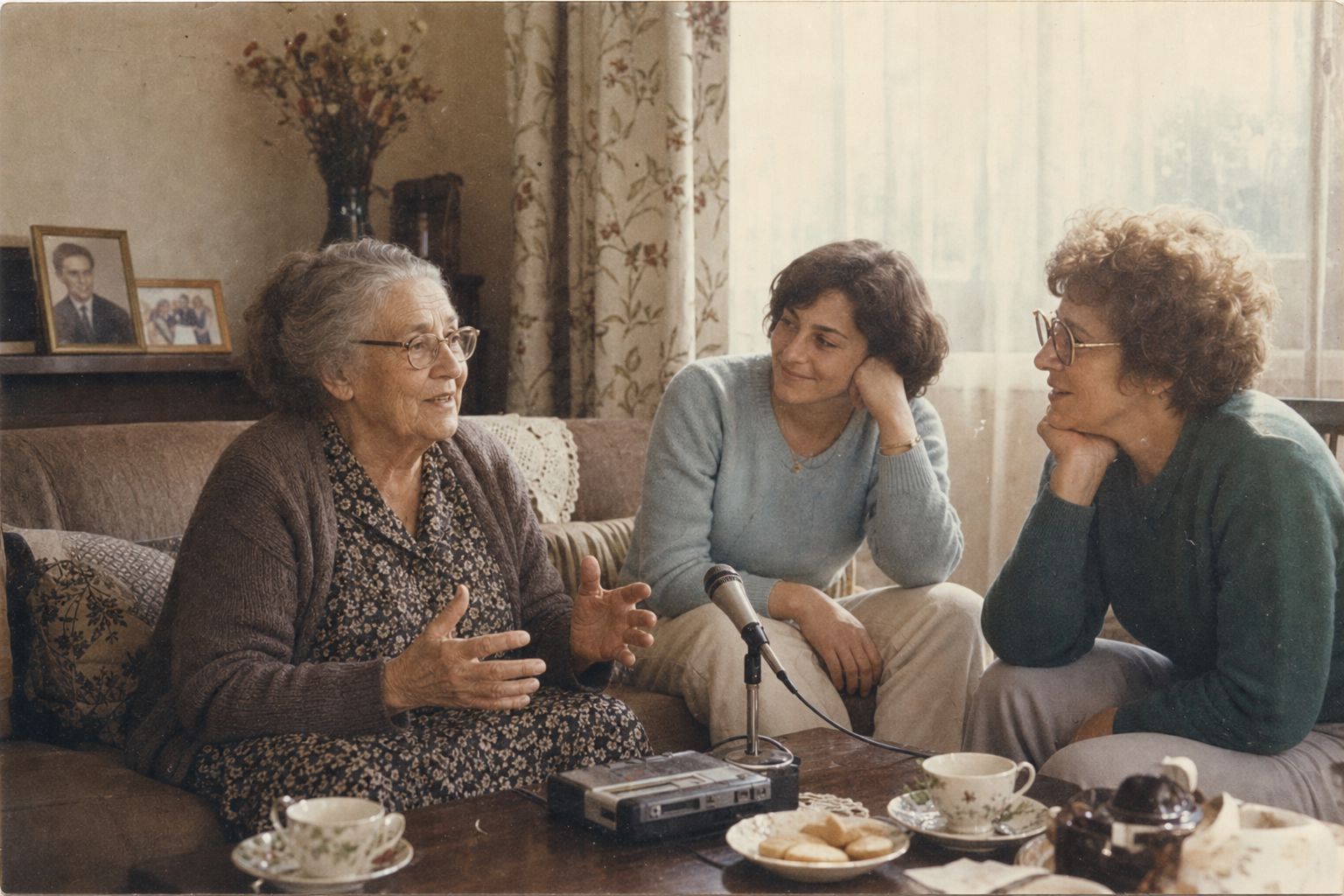
"I have so much to tell, but I don't know how to write." This phrase, uttered with an apologetic smile, has buried more life stories than oblivion itself. Yet, freeing one's voice without the burden of writing is something everyone can do today: simply tell your story aloud.
How many stories lie dormant, held back by the fear of doing it wrong? Entire childhoods, lost professions, loves, exiles, reconstructions. Their custodians remain silent, convinced that storytelling requires a literary talent they supposedly lack.
Everyone has always known how to speak. And now, speech can become a book.
The blank page, a wall that silences too many stories
Facing paper, many relive an old scene: dictation, a paper returned covered in red marks, the feeling of never having been "good at French." School has left generations with the idea that writing belongs to those who master it. As adults, we dare to write a shopping list, but rarely our memoirs.
In addition to this intimidation, there are very concrete obstacles: the time writing demands, visual fatigue, arthritis that makes holding a pen painful, or simply the anxiety of the first line. The project of writing one's biography is then postponed year after year, until it becomes a regret.
Yet what the family expects are memories, the voice, the truth of a life. Good syntax comes later, and it can come from elsewhere.
Telling stories aloud, the oldest way to transmit
Long before books, human memory circulated through speech. Vigils, tales, war stories or harvest narratives: for centuries, family transmission was oral. The great foundational epics of our culture were told and retold long before they were recorded by scribes.
Telling stories aloud mobilizes what is most natural to us. The voice carries emotion, hesitations, laughter, everything that the page struggles to capture. A recounted memory is accompanied by a tone, a rhythm, a warmth that are part of the memory itself.
Rediscovering this ancient gesture means reconnecting with an obvious truth: we transmit first by speaking.
When the burden of writing fades, speech is liberated
The two exercises solicit different resources. Writing requires thinking about spelling, structure, punctuation—all guardians that filter spontaneity. Speaking follows the thread of memory, which advances through associations, digressions, and images.
This is why an interview brings up details that writing would have left buried: the smell of bread in the kitchen, a neighbor's nickname, the color of a wedding dress. Speech unearths what the page intimidates. Biographers know this well: their best pages are born from a conversation.
Finally, there is a liberating dimension, similar to what psychologists observe in talk therapies: saying aloud what one has carried in silence lightens the burden. A life story often begins with a sense of relief.
From voice to book: dictating your life story
For a long time, only those who could afford a ghostwriter or a professional biographer transformed their speech into text. Technology has changed the game: it is now possible to dictate your memories and see them take the form of a structured narrative.
This is the principle we have adopted at Elefantia. The application asks questions, and you answer by speaking, as in a conversation. Your words are transcribed, organized, and formatted with the discreet help of artificial intelligence, and you review each step. Those who wish for a human presence can proceed with a biographer, who conducts the interview and shapes the text alongside them. At the end of the journey, a printed book, with your story and your tone.
The person who "didn't know how to write" then discovers that they had always known how to tell a story.
Authenticity is better than perfection
Should we fear that a dictated story is less beautiful than a written one? Experience proves the opposite. Readers of a life story seek a presence, a recognizable voice. A simple sentence that rings true is more touching than an elegant phrase that rings false.
The most beautiful family biographies also retain traces of oral tradition: favorite expressions, regional idioms, unintentional humor. These rough edges add value to the text, as the family recognizes a beloved voice within it. Smoothing out this grain would mean losing the essence.
Perfectionism is a writer's luxury. For transmission, sincerity is enough, and it is within everyone's reach.
Your story is just waiting for you to tell it
All that remains is to take the first step, and it is smaller than you think: answer a question. How did your parents meet? What was your first home like? What day did your life change?
Say the answer aloud, to a loved one, to a recorder, to an application. The rest will follow, question after question, memory after memory, until the story of an entire life unfolds.
Thousands of stories have been lost because their witnesses believed writing was forbidden to them. Yours can escape this silence. Your voice is enough.

Share:
Tribute to a deceased loved one: writing their life story
Family Memories: Building Bridges Between Generations