

Where are pre-internet memories? Those that our elders never typed on a keyboard, never posted on a network, never saved in a cloud. Yet they exist, by the thousands, in the memories of our parents and grandparents. The question of digital heritage arises here with particular acuity: how can we give this story, born outside the digital realm, the means to endure through time?
Our elders grew up in a world where one didn't document their life. Workdays, village festivals, the emotions of big days were lived without leaving any trace other than memory. Their stories remained in the quiet of conversations, whispered around a table, then put away in silence.
We are the first generation that can change their destiny. The tools now exist to capture these words, transcribe them, preserve them, and transmit them. But we must seize them while the voices are still present.
A generation rich in stories and poor in traces
The paradox deserves to be faced head-on. Generations born with the internet leave behind tens of thousands of photos, messages, and videos. Previous generations leave a few albums, official papers, and, with a bit of luck, a box of letters.
Between the two, the gap is astounding. A teenager today documents more of a week of their life than a man born in 1940 documented his entire existence. Yet it is precisely these lightly documented lives that hold the most precious memories: a vanished rural world, extinct trades, ways of life of which nothing else bears witness.
Historians of daily life often remind us: official archives preserve events, almost never the experience. Without direct testimony, future generations will know what happened, but never how it was lived.
Digital doesn't erase the past; it can save it
Screens are often accused of cutting families off from their memory. This overlooks the other side of digital: never has a technology offered so many ways to collect and preserve spoken words.
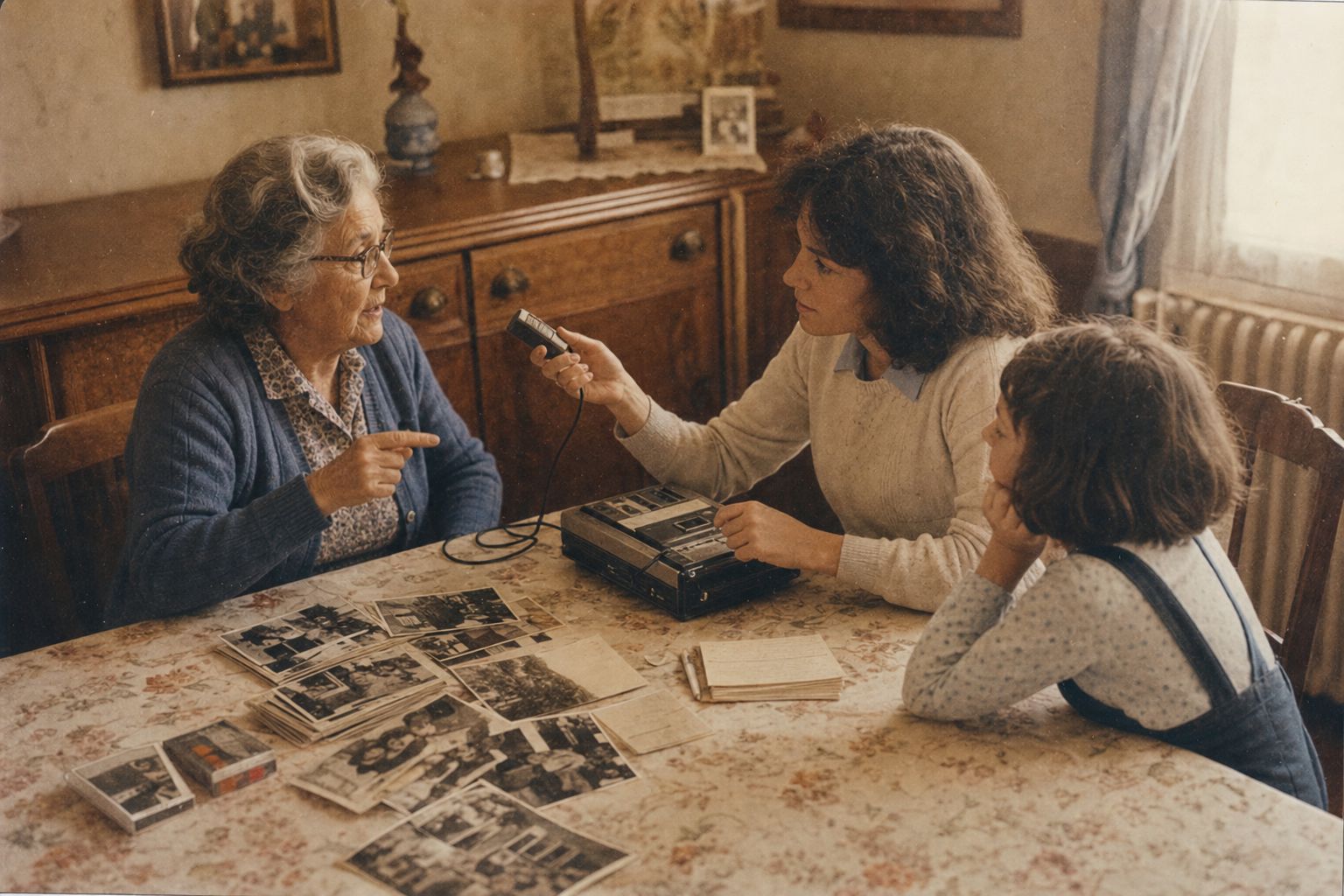
A smartphone placed on the table records an entire conversation. Speech recognition transcribes a narrative into text. An audio file forever captures the timbre of a voice, its hesitations, its accent, its laughter. What families of old would have paid dearly to possess, everyone now has in their pocket.
Digital heritage then takes on a new meaning. It is no longer just about managing the accounts and photos we will leave behind. It is about offering pre-internet generations a place in tomorrow's memory: digitizing their stories means giving them a voice that will carry further than they did.
How to transform an elder's story into lasting heritage
It all starts with a conversation. A precise question, asked on a Sunday, opens up memory better than a grand declaration of intent: the childhood home, the first job, meeting one's partner. The recording, made with the person's consent, captures this raw material without demanding anything from them.
Then comes the work of formatting. Raw speech is moving, but a structured narrative is transmitted better: chapters, a thread, interconnected episodes. This is where technology provides its greatest service, transforming hours of conversation into an organized text that the family can read.
This is precisely the path we wanted to simplify at Elefantia. Our application asks questions, orally collects the elder's words, transcribes them, and helps structure them into a life story, chapter by chapter. Families who prefer a human presence can entrust interviews to a biographer, who listens, prompts, and organizes the narrative. Technology fades away, the voice remains.
From file to book, heritage needs two formats
Should we then bet everything on digital? Prudence calls for nuance. Formats age, platforms close, passwords get lost. A heritage entrusted to a single hard drive remains fragile.
The safest solution combines both worlds. Digital for capturing, transcribing, duplicating, and sharing stories across the family. Paper for longevity: a printed book sits on a shelf, can be browsed without a password, and is found intact in an attic fifty years later.
A recording of your grandmother's voice and the book of her life placed in the family library: this is a complete, meaningful, and lasting legacy all at once. One keeps the timbre, the other keeps the story.
Tomorrow's children will hear what we have captured
Imagine the scene thirty years from now. A grandson plays for his own children the voice of a great-great-grandmother recounting her chalk-filled school days, her harvest summers, her post-war marriage. Then he opens the book where this life is told, and the faces in the photos finally find their stories.
This scene depends only on us, and it is decided now. The words of pre-internet generations are still waiting in memories, available, alive, ready to be collected. Each passing month carries a part of them away.
So, which memory of your elders would you like to safeguard first? The answer to this question is probably the best starting point. A visit, a question, a recording: your family's digital heritage can begin this very weekend.
Share:
Aging Well in the Digital Age: A New Chapter
Family stories: better understanding our past