

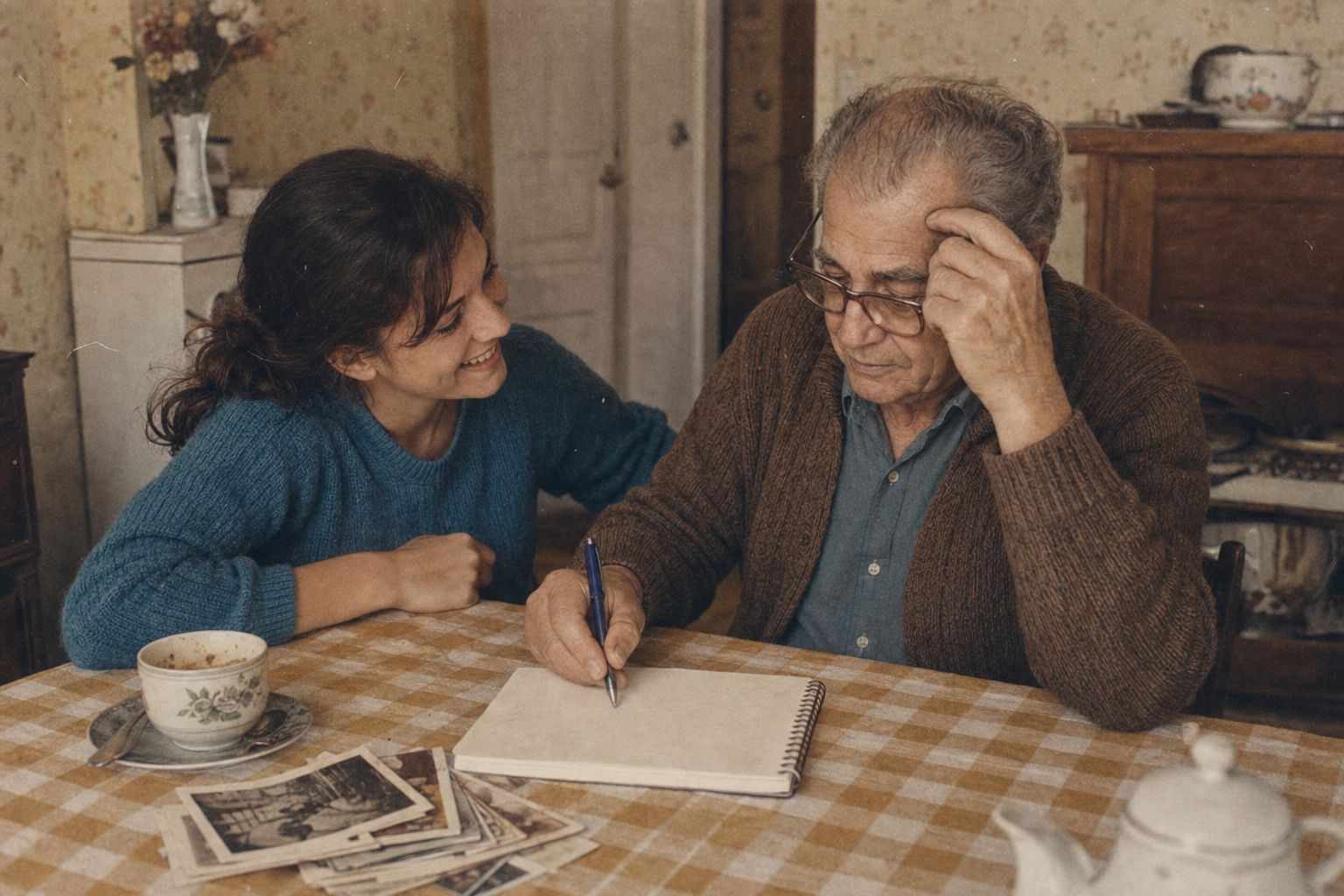
"I wouldn't know. I've never been good at writing." We hear this phrase every time it comes to telling your story, your journey, your memories. The desire is there, often for years. The legitimacy, however, seems to be missing, as if a lifetime's memory had to pass a style exam before being allowed to be transmitted.
This feeling is based on a profound misunderstanding. It confuses literary talent, which belongs to artists, and the act of bearing witness, which belongs to everyone, and always has.
This article aims to unravel this misunderstanding and restore a freedom that school, the cult of beautiful style, and the fear of judgment have ultimately confiscated: that of telling your story in your own words.
Where does this feeling of illegitimacy towards writing come from?
For many of us, writing remains associated with classroom memories: dictation, errors underlined in red, essays graded out of twenty. We were taught early on that writing is judged, rarely that it is shared. Decades later, the hand still hesitates over the page, as if an invisible corrector were reading over our shoulder.
Added to this is the immense prestige of literature. Faced with a well-stocked library, everyone measures the distance separating them from the great authors and concludes that it is better to remain silent. Linguists have a name for this phenomenon: linguistic insecurity, this permanent doubt about the value of one's own way of speaking and writing.
However, this doubt makes us confuse two very different actions. Creating a verbal work of art is a profession. Transmitting a memory is a universal human need that has never required a diploma.
Telling your story is first and foremost an act of bearing witness
Long before the printed book, life stories circulated at evening gatherings, around the fire or the family table. No one asked the grandmother who was recounting her childhood to have style. They asked her to remember, with precision and sincerity. Oral transmission carried family memories for millennia without ever demanding writers.
Think also of the letters sent from the front by soldiers of the Great War. Many were clumsy, hesitant about spelling. Yet families preserved them as relics, and historians study them today with passion. Their strength comes from their truth, from what they say about a man, a fear, an era.
A life narrative follows the same logic. Its value lies in the authenticity of memories, the accuracy of details, and the unique voice of the storyteller.
What your readers truly expect from your story
Ask yourself who will read your book: your children, your grandchildren, a curious nephew, a few close friends. None of them will open it to evaluate the syntax. They will read it to find you, to hear your way of speaking, to discover how you navigated your time and your trials.
In a family memoir, the concrete detail is worth all rhetorical flourishes: the smell of bread in your mother's kitchen, the sound of the workshop, the bike ride to school, the emotion of the first day of work. A simple sentence that rings true touches infinitely more than a labored metaphor.
Loved ones immediately recognize a direct, familiar language, the one they have always heard. This voice, your voice, is precisely what a life story must preserve.
Writing feels good, even without literary pretensions
Psychology has long studied this act. James Pennebaker's work on expressive writing has shown that putting experiences into words, even awkwardly, helps to organize them, give them meaning, and calm what remained confused. The benefit comes from the act itself, regardless of the quality of the prose.
Gerontology observes the same thing in seniors: reminiscence, the act of revisiting and recounting one's life, strengthens the sense of identity and continuity. Telling one's story helps to re-read one's journey, to find coherence in it, to make peace with certain chapters.
In other words, the benefits of autobiographical writing are open to everyone, just as walking is beneficial without requiring one to be an athlete.
You tell the story, others can help you write it
For a long time, only public figures or wealthy families could afford a biographer. This barrier is now falling, and this is precisely the conviction that gave birth to Elefantia: everyone should be able to write their life story, alone or accompanied, right up to the printed book.
In concrete terms, you can simply tell your story, aloud or in fragments, as memories come. The application organizes your memories, artificial intelligence discreetly helps with formatting, and our biographers, the Elefantos, accompany those who prefer to proceed together. Your voice remains intact from beginning to end: it is simply carried through to the book.
The expertise this project needs, you already possess entirely. You are the only person in the world who knows your life from the inside.
Perfection has never transmitted a single story
Waiting to "know how to write" before starting almost always means never starting. Meanwhile, memories fade, dates get mixed up, faces pale. Transmission prefers imperfect narratives to definitive silences.
Your grandchildren will never compare your book to a literary prize winner. They will place it among the most precious family heirlooms, because it will contain your perspective, your anecdotes, your journey through the century.
So start small: an anecdote, a place, a face. Tell it as you would tell it at the dinner table on a Sunday. The rest will follow, one memory calling forth another. And if anyone tells you that you have to be a writer to tell your life story, simply reply that the most beautiful family stories have never asked literature for permission.

Share:
Memories of Our Elders: A Family Treasure to Pass On
Aging well: sharing memories and stories