

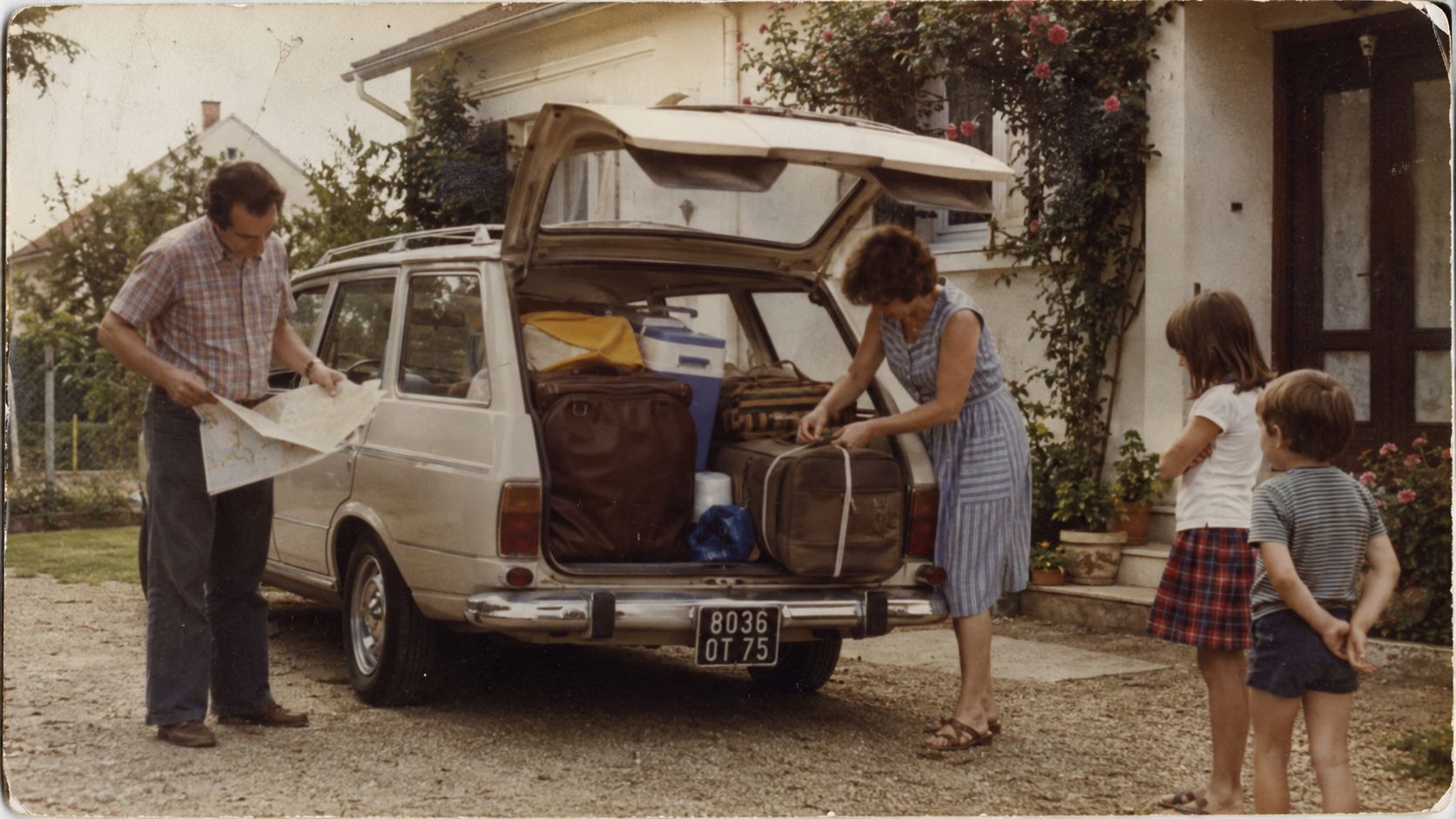
"My life is nothing extraordinary."
This is the objection we hear most often. The feeling that one's own existence has been, all in all, rather ordinary. Not exciting enough, not remarkable enough to deserve a book.
It's a sincere feeling. But it's just a feeling, not a truth. And above all, it misses the essential point: when you tell your life story, you're not writing for the past. You're writing for the future, and for those who will come after us.
"Ordinary" is precisely what gets lost
What we consider commonplace in our own lives is precisely what disappears most quickly. Major events are preserved by history. But the texture of daily life (how people lived, what they ate, how they talked to each other, what they hoped for, what they feared) leaves almost no trace. No one archives it. It fades away with those who lived it.
That's why so-called "ordinary" lives are often the most valuable to pass on. Not because they are spectacular, but because they are the only ones that can recount an era from the inside.
To tell your life story is to write about your era, much more than to list achievements.
Your life story writes the roots of your own family
A life story is first and foremost a gift for those who are not yet here to read it.
It's, immediately, a sixty-year leap: your children, your grandchildren will find in it where they come from, who you really were, what shaped the family they inherit. But this leap can go much further. A book is passed from hand to hand, from generation to generation. Nothing prevents a great-grandchild, a century from now, from opening your pages and hearing your voice.
This is what it means to provide roots: to offer those who follow a solid anchor point, an answer to the question everyone eventually asks themselves:
"Where do I come from?"
Paper withstands time better than we think
It's sometimes objected that digital is more durable than paper: a file doesn't burn, doesn't yellow, doesn't get lost. This is an illusion.
Digital is, in reality, remarkably fragile. Formats become unreadable, platforms close, accounts get lost, drives die silently. How many photos, videos, messages have you already lost when changing phones or applications?
A book, on the other hand, requires no password, no update, no connection. It sits on a shelf and waits. It can be found in an attic, intact, decades later. The printed object remains, to this day, one of the most reliable mediums humanity has invented for traversing time.
What you write on paper today has a good chance of still being read when everything else has disappeared.
Without the narrative, only silent images remain
Imagine your descendants, fifty or a hundred years from now, trying to understand who you were.
If they only have photographs, their task will be arduous. They will have to guess, interpret, invent. Who is this person next to you? Why that smile? What happened that day? An image freezes a moment, but it says nothing about what was felt, or why it mattered. It remains silent.
The narrative, on the other hand, gives a voice. It connects faces to stories, places to emotions, dates to life choices. It transforms a collection of enigmatic images into a living, transmissible, comprehensible memory.
What is difficult for you today, taking the time to tell your story, will be infinitely more difficult for them tomorrow, if they have to reconstruct everything without you.
Writing one's story: an empathetic gesture, not narcissistic
There remains the last hesitation, the most modest: "Isn't it a bit self-centered to tell one's life story?"
It's quite the opposite. Writing your story is a gesture directed towards others much more than towards oneself. It's empathy for all those who, later, will feel that particular, almost indescribable emotion one experiences when reading where one comes from.
Anyone who has held the words of a deceased parent or grandparent in their hands knows this: it is a treasure. To offer that to one's own is one of the most beautiful gifts one can give.
Yes, it's an effort. But it's an effort worth making, and one that you don't have to undertake alone. Today, an application and, for those who wish, human support make this act much simpler than before. What matters is what will remain, much more than the writing performance itself.
To write is to reach out across time
So no, you are not writing to dwell on the past. You are writing for faces you may never see, but who, one day, will seek you out.
And that day, thanks to you, they won't have to guess or interpret. They'll just have to open a book, and read you.

Share:
Why Women Write: Words on Woes
Cadeau de Noël grands-parents : le livre de leur vie