

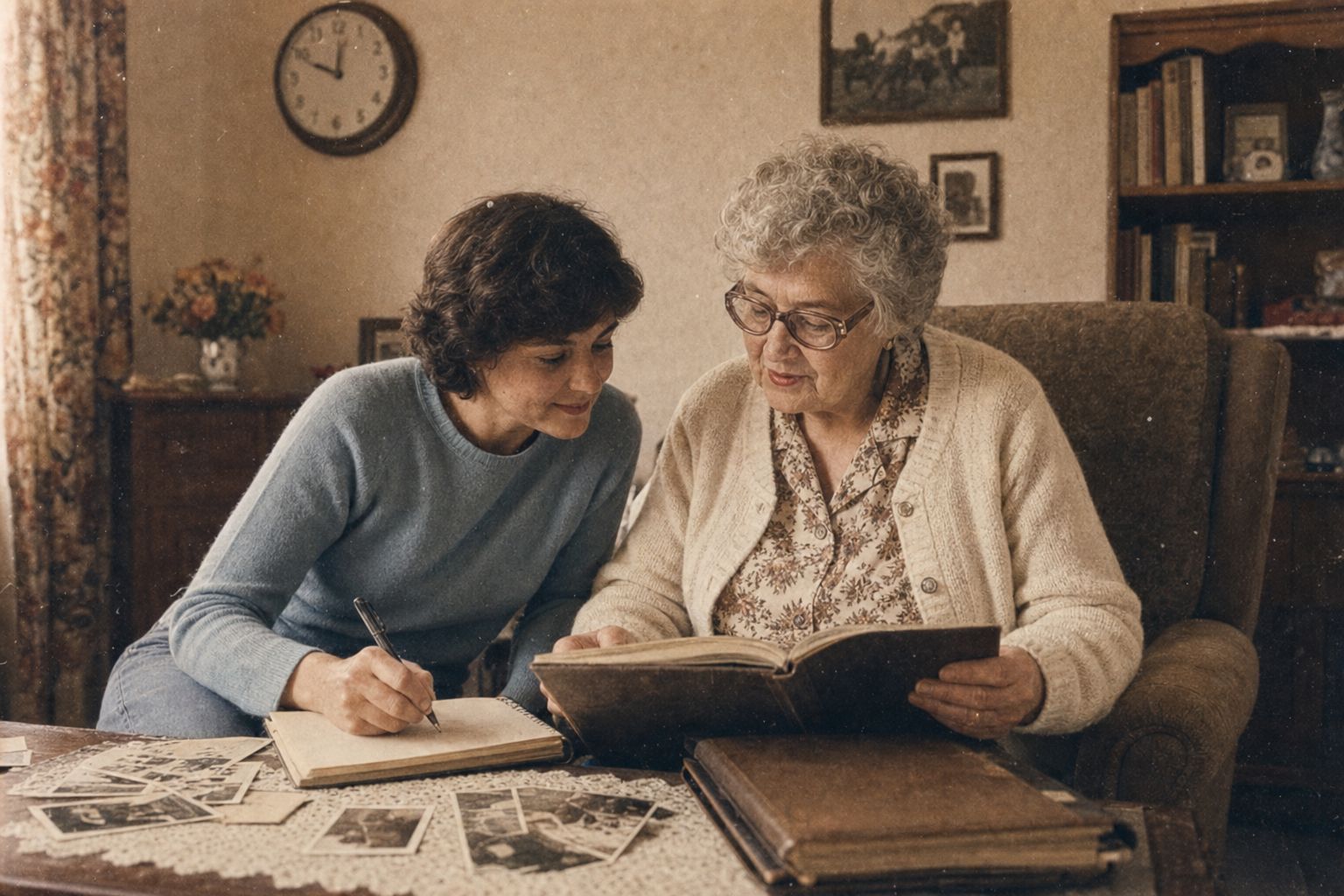
For the loved ones of a deceased person, reconstructing the chronology of their life often resembles a caving expedition. Headlamp and harness: you have to interview those who knew them, retrace places and dates, decipher old papers, sometimes open private diaries that remained confidential. Writing one's biography during one's lifetime spares loved ones this long exploration in the dark.
Because it is difficult for descendants to navigate the darkness of the past. The walls are slippery, handholds are scarce. One misinterpretation, and you follow a false trail until you get lost in the meanders of memory.
This image speaks volumes about what is at stake for a family surrounding a life story. And about the discreet urgency of getting started.
These regrets we hear so often
When we talk about Elefantia, the same phrases come back, almost word for word: "it's a shame, I wish I had done it before she left," "we started, we never finished," "I promised myself I would write everything down, and time ran out." These confidences are moving and sad.
Let's be clear: writing a biography will never resolve grief. Every death is an individual and family tragedy, which always occurs too early in the lives of loved ones. You never fully recover, and the absence stays with us until the end.
But these regrets express one precise thing, which deserves to be heard: transmission was possible, even desired, and it was simply postponed until the day it ceased to be possible.
We never regret the time spent on transmission
Conversely, a certainty emerges from all the stories entrusted to us: no one regrets the hours spent collecting or transmitting a life story. Whether in written or oral form, individually or collectively, as an amateur or with a professional, leaving one's voice always has value, for oneself and especially for the people we love.
When we lose a loved one, every saved voice message, every video where their face comes alive, gives us a brief moment of feeling like we're with them again. We listen to them again, we watch them endlessly. When the recording stops, the pain returns, but for a brief moment, the magic worked.
These fragments are precious. Yet they remain scattered shards, moments without a common thread. A complete life story gives them a framework, continuity, a history.
A text leaves a deeper impression than an image
A text provokes a different emotion, less sudden, less dazzling. It shows neither the sparkle in the eyes nor the timbre of the voice. In exchange, it offers something that images rarely provide: duration, depth, interiority.
A text leaves a more lasting trace. It gives another dimension to the memory of a person, invites reflection, introspection, a gentle nostalgia. It evokes affection, attachment to shared memories, to past anecdotes. It transmits love and inscribes it in the long run.
We reread a passage as if paying a visit. Thirty years later, the pages still open, without batteries, without a screen, without a format that has become unreadable. The words wait, patiently, for those who will need them.
Writing one's biography enlightens those who remain
Grief is a dark period. A biography illuminates the cave of memories, the depths of family memory. It provides keys and landmarks: dates, places, decisions finally explained, chapters told by the person themselves rather than reconstructed by hypotheses.
It spares descendants painful suppositions and unanswered questions. Who were our parents really before us? Why this departure, this profession, this silence? The life story answers firsthand, in the words of the person concerned.
A biography is a soft light that illuminates the memory of a person for a long time, a distant echo that guides the work of memory. And the words resonate for a long time in the dark.
Writing one's biography also does good during one's lifetime
"Too late" does not only concern death, by the way. Memory gently erodes, long before the great departure: names fade, dates merge, details disappear. Each passing year takes away a little bit of substance.
Writing early means writing better, with memories still vivid. It also means offering oneself an inner journey whose benefits are well-known: revisiting one's life, what psychologists call reminiscence, helps to organize one's journey, to measure the path covered, to finally say what had never been said.
Many discover a coherence they had never seen while writing, and close certain chapters feeling at peace. The biography primarily benefits its author before serving its readers.
The right time will always be when you start
Writing can be experienced in the pleasure of transmission, far from any anxiety about the end. A life story is built at its own pace, one memory after another, one conversation after another. Our biographers observe it every week: once the first anecdote is told, the subsequent ones follow naturally.
Start modestly. Record a conversation with your mother this weekend. Write down the story your father has been telling for forty years tonight. Write the first page of your own story, the one your grandchildren will one day look for.
"Before it's too late" seems a somber phrase. Let's reverse it: there's still time, right now. And the time dedicated to transmission will, no matter what happens, be time no one regrets.

Share:
Writing about yourself when you think you've led an ordinary life
Writing a book about one's life to leave a legacy