

The phone rings less often, visits become rarer: the isolation of seniors almost always sets in this way, stealthily, in a silence that radio or television can only partially fill.
Retirement, widowhood, children moving away, reduced mobility: connections unravel one by one, often silently. Yet, within earshot, there is a disarmingly simple remedy: sharing memories.
Recounting a moment of one's life, listening to another's. This small act reweaves connections where solitude had settled, and it transforms both the speaker and the listener.
The isolation of seniors, a silent and growing reality
The loneliness of seniors rarely sets in all at once. It proceeds through successive withdrawals: the end of professional life removes a social role, the death of a spouse empties the home, friends move away or pass on, travel becomes difficult.
Gerontologists regularly remind us: involuntary loneliness affects morale, sleep, appetite, and even physical health. Feeling isolated often amounts to feeling useless, and this feeling of uselessness erodes more surely than age itself.
Digital tools reduce distance without entirely bridging it. A video call is pleasant, but it often remains superficial: we catch up, talk about the weather, and each returns to their day. What is missing is a truly engaging conversation.
Why sharing memories is so effective in combating loneliness
Shared memories possess a rare quality: they immediately add depth to an exchange. When an elderly person recounts their first job, their wedding, or the summers of their childhood, the conversation leaves trivialities behind to touch upon the essential.
Gerontology has given a name to this phenomenon with the concept of reminiscence: voluntarily recalling one's past, alone or with others, helps maintain self-esteem and a sense of identity. Reminiscence workshops exist in many residences and associations precisely because these exchanges are beneficial.
Finally, there is reciprocity. The one who recounts gives something precious; the one who listens receives and, through their questions, shows that this experience matters. The elder then regains another status: that of a source, a witness, a storyteller sought out for who they are.
Memories that restore a place in the family
In many families, roles become fixed with age: we talk about elders, we organize for them, we look after them. Sharing memories gently reverses this perspective. The grandparent once again becomes the one who knows, the one who has lived, the one who holds the keys to family memory.
For grandchildren, these stories are a discovery: an era recounted by someone who lived through it, a vanished profession described from the inside, the youth of their own parents seen by a direct witness. History suddenly takes on a familiar face.
These conversations leave lasting traces. A memory told on a Sunday becomes a common reference, an anecdote that is repeated, a thread that connects generations long after the visit.
How to encourage these daily exchanges
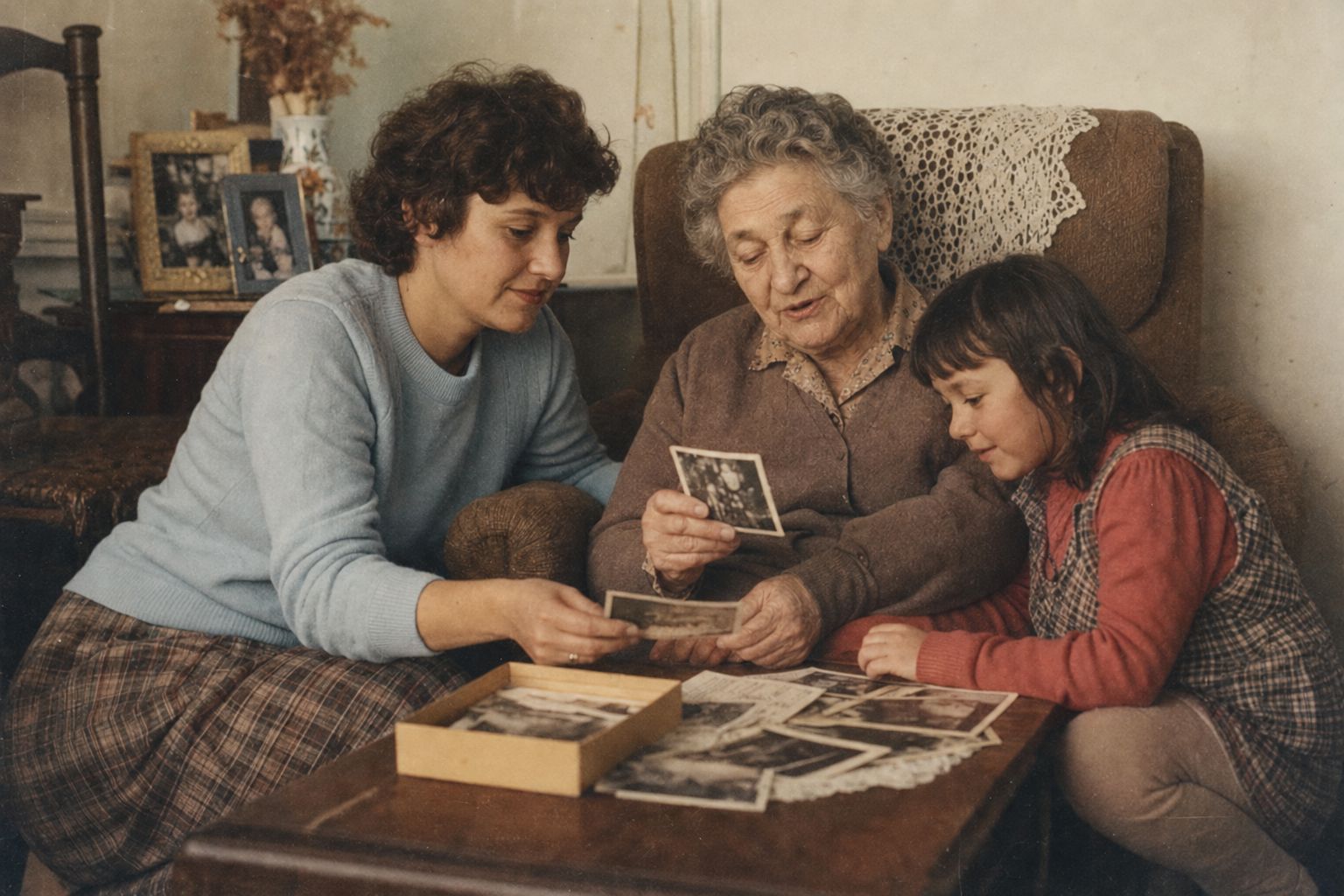
No need for a solemn setting. A photo taken from a box, a family recipe prepared together, a song from a bygone era are often enough to open up memories. Objects are excellent memory triggers.
Specific questions work better than general ones. "What was your room like when you were ten?" awakens concrete images, whereas "Tell me about your childhood" can leave someone speechless. Genuine curiosity does the rest, provided you listen without rushing.
Regularity matters more than duration. A weekly call dedicated to a memory, a monthly visit around a photo album: these small rituals give the elder something to look forward to, and the anticipation itself already dispels some loneliness.
When shared memories become a life story
These conversations sometimes deserve to extend beyond the moment. Writing down the collected memories, organizing them, making them into a life story or a biography: the project gives the exchanges a horizon, and the family a treasure.
This is the path we offer at Elefantia: an application to collect and write memories at one's own pace, and biographers to accompany those who prefer to proceed together, up to the printed book. Many families discover that the project itself, with its appointments and questions, creates exactly the connection that was missing.
For a book of memories can be reread, lent, and passed down. It extends the elder's voice long after visits, and it reminds everyone that this recounted life is part of their own.
A conversation can be enough to reopen the world
Isolation is fought by public policies, associations, and attentive neighbors. It is also fought at the family level, one memory at a time.
The next time you visit an elderly relative, try the experiment: ask a real question about their life, then listen without watching the clock. You will see a light in their eyes, details resurface, a whole person reappear behind their age. And you will almost always leave richer than when you arrived.

Share:
Writing Your Story: New Year's Resolution
Sharing your life story: a bridge between generations