

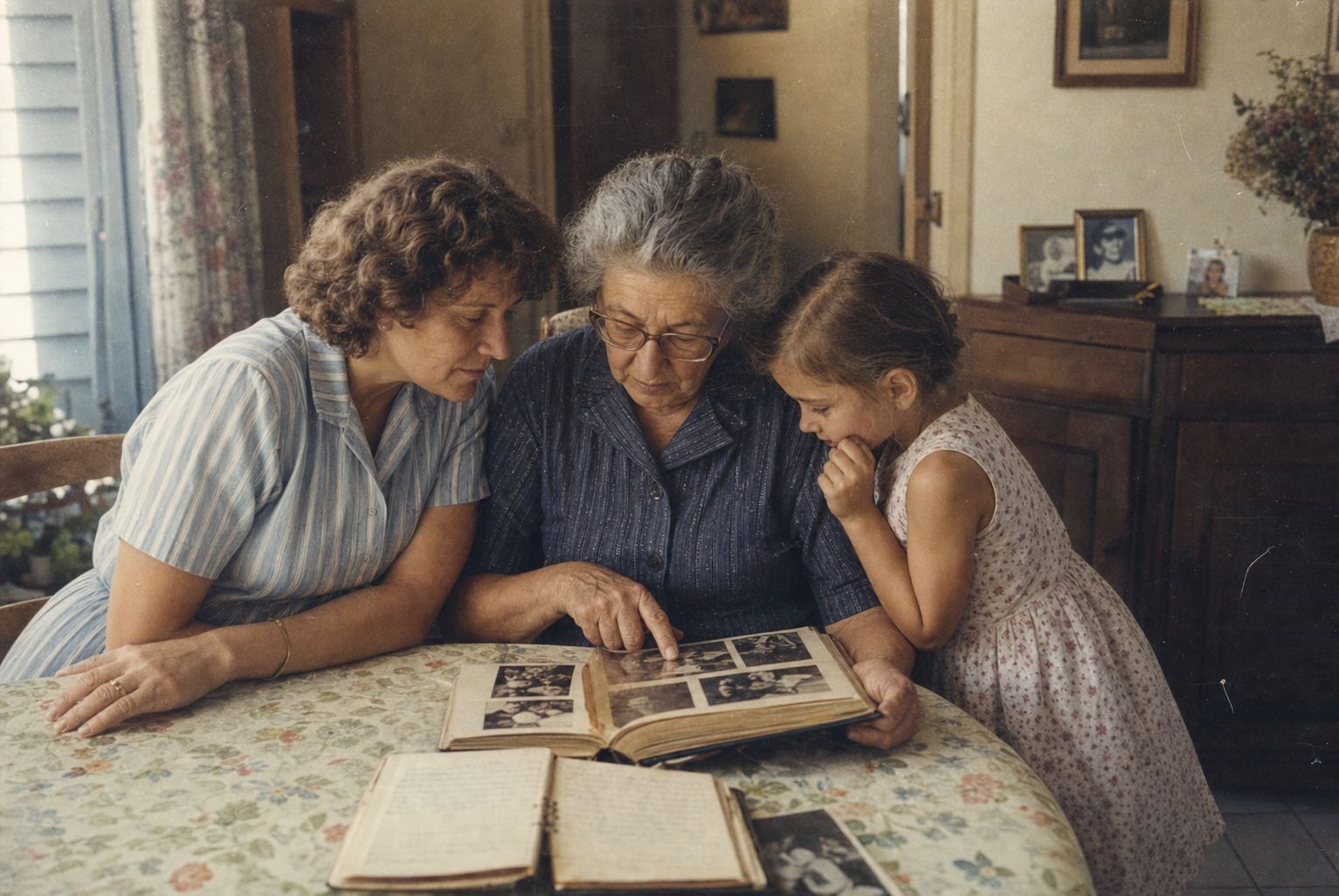
Sometimes all it takes is a question asked at the right moment. "How did you meet grandpa?" An ordinary Sunday then takes a turn: conversations cease, all eyes turn to the same person, and someone begins to tell their life story.
The art of storytelling is one of humanity's oldest gestures. Long before books, families passed down their history at twilight gatherings, from memory and by voice. This need has lost none of its power in the age of screens; it has only become more discreet, due to lack of time, opportunities, and sometimes courage.
It deserves to be fully reinstated. Because when an elder recounts their journey, they do much more than just remember: they build a bridge between generations, and everyone, from the youngest to the oldest, emerges a little changed.
Telling one's life story first transforms the storyteller
Gerontology has long been interested in the virtues of reminiscence, this voluntary return to memories. As early as the 1960s, American geriatrician Robert Butler described "life review," the natural movement by which an older person revisits their existence to give it meaning and coherence.
Putting words to one's past helps to reread challenges with perspective, to measure the journey traveled, to reconcile the scattered chapters of an existence. Many elders discover, while recounting, a continuity they did not suspect: the young apprentice, the mother, the retiree finally form one single story.
An more immediate benefit is added: the storyteller feels listened to, useful, recognized. Their experience once again becomes a solicited asset, at an age when society too often conveys a feeling of uselessness.
What elders' stories offer to the younger generation
On the other side of the bridge, children and grandchildren receive much more than anecdotes. Psychologists working on narrative identity regularly observe this: knowing one's family history helps to build one's own. Knowing where one comes from provides a foundation for deciding where one is going.
The life stories of elders are also embodied lessons in resilience. Hearing how a grandmother went through a bereavement, an exile, or a career change speaks louder than any discourse. These stories show that an existence is built with detours, overcome failures, and new beginnings.
Finally, they offer a valuable counterpoint to contemporary immediacy. For an adolescent, discovering their grandfather's youth, his expectations, his slowness, and his simple joys, means broadening their temporal horizon and putting the pressure of the present into perspective.
Family memory is a fragile heritage
We always think we have time. Then one day, the person who held the memories passes away, and with them entire sections of family memory: the name of the original village, the circumstances of a meeting, the truth of an episode no one dared to address.
Oral memory is precious but volatile. It distorts with repetition, diminishes when opportunities to meet become scarce, and disappears when witnesses are gone. Each generation that remains silent leaves the next with a diminished heritage.
Hence the importance of recording these stories: recording them, writing them down, turning them into a biography or a family book. The act of writing changes everything, because it makes the memory transmissible far beyond the circle of those who heard it.
How to help an elder tell their life story
Telling one's life story requires favorable conditions, and this must be prepared with delicacy. The first lever is the open question: "Tell me about your first day of school" opens many more doors than a vague "What was it like before?". Specific questions awaken images, smells, faces.
Props help a lot. A photo album, a rediscovered letter, a family object, a period song: all these triggers bring back memories thought to be lost. A walk in a childhood neighborhood can be worth hours of conversation.
Finally, we must accept the rhythm of memory. Some memories come immediately, others require several conversations, some silences, a little trust. Regularity counts more than duration: short and frequent appointments are better than one long, solemn session.
From speech to book, so the bridge remains
It is precisely this transition, from spoken word to structured narrative, that we support at Elefantia. Our application guides those who want to write their story or that of a loved one, question after question, memory after memory, up to the printed book. Those who prefer support can proceed with a biographer, at their own pace.
However, the essential thing remains the act itself. Whether it takes the form of a book, a handwritten notebook, or carefully preserved recordings, the life story has one purpose: to last longer than the voice that carried it, and to remain accessible to the generations that will come after it.
What if the next story started at your home?
Every family has its stories: great journeys and tiny joys, exploits and turning points, laughter and scars. They are just waiting for an opportunity to circulate again.
You can create this opportunity at your next family meal. A sincere question, true listening, and the bridge between generations begins to build. Today's children will thank you tomorrow for having collected these voices while there was still time. And perhaps you will discover, by listening to your elders tell their lives, that their story also illuminates yours.

Share:
Senior isolation: sharing memories as a remedy
Writing about yourself when you think you've led an ordinary life