

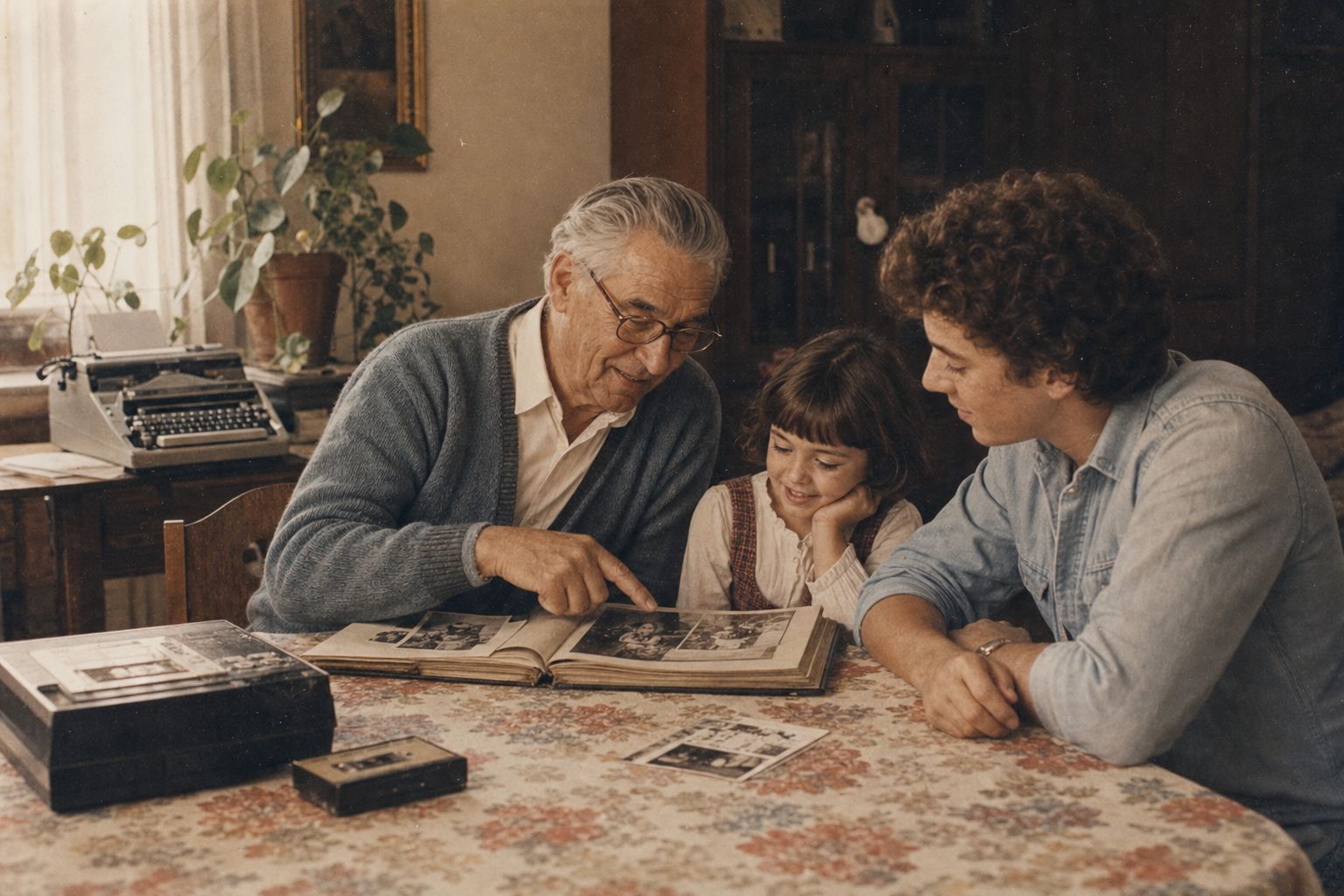
"At my age, those things aren't for me anymore." Many families have heard this phrase when they've given a tablet to an elderly relative. It reflects a genuine apprehension about a fast-moving world that seems to speak a different language.
Yet, aging well in the digital age has become a concrete reality for a growing number of seniors. Video calls with grandchildren, shared photo albums, voice messages circulating between three generations: when well-designed, today's tools strengthen family ties on a daily basis.
Among all these uses, one touches on the essential: the possibility for every senior to write their life story and transmit their family memory in a form that will stand the test of time.
Digital technology, long perceived as a barrier, becomes a bridge between generations
For years, the digital divide fostered a sense of exclusion among many elderly people. Mandatory online forms, counters replaced by screens, dematerialized procedures: progress seemed to be moving forward without them.
The recent period has changed the situation. Interfaces have been simplified, voice command has become commonplace, and seniors have adopted uses that are meaningful to them. In gerontology, it is observed that motivation makes all the difference: a senior readily learns a tool when it brings them closer to their loved ones.
Digital technology then rediscovers its most beautiful vocation: to enable one to remain present in the lives of those they love, even at a distance, even when visits become less frequent.
Aging well in the digital age means remaining the author of one's own story
Aging specialists agree on one point: aging well encompasses physical health, mental vitality, and the quality of social connection. The feeling of remaining useful, listened to, and recognized weighs as much as physical exercise or nutrition.
However, the digital age offers seniors an unprecedented opportunity to occupy this place. By recounting their journey, commenting on old photographs, and recording their memories, they become the living source of family memory again. Gerontologists use the term "reminiscence" to describe this process of evoking the past, recognized for its calming and structuring effect on the elderly person.
To hold the pen of one's life, even at eighty, is to affirm that one remains the author of one's story, with a perspective that no one else can ever provide in their place.
Fragile memories finally find lasting support
Every family knows this dizzying feeling: boxes of unlabeled photographs, yellowing letters, faces that no one can name anymore. Family memory often rests on a single thread, that of one person's words.
The digital age allows this thread to be strengthened. A recorded voice, a dictated memory, an anecdote noted on an application: all fragments that can be gathered, organized, and then transformed into a true life story. The final gesture, the printing of a book, gives these fragments a tangible form, transmissible from hand to hand.
Technology here serves as a bridge: it collects, structures, and formats. The book, meanwhile, remains, placed on a shelf, ready to be opened one day by a grandchild curious about their roots.
Writing your biography becomes an accessible, step-by-step project
The question many seniors ask themselves remains: where to start? The idea of writing one's biography is daunting, especially when one has been out of school for sixty years and has never felt like a writer.
It is precisely to overcome this obstacle that support solutions have emerged. At Elefantia, we have designed an application that guides the person through simple questions, allows them to speak if they prefer to talk, and offers, for those who wish, the human support of a biographer. The writing progresses at its own pace, chapter by chapter, until the printed book.
The important thing is this idea: no one should give up transmitting their story for fear of not being comfortable with words or screens.
Families play a decisive role in this new chapter
A life story project often originates from an outside perspective. It's a daughter who offers the application to her mother, a grandson who sets up the tablet and asks the first question, a caregiver who notes repeated anecdotes during visits.
This companionship changes everything. It transforms digital learning into a shared moment, and the collection of memories into conversation. Many families discover entire episodes of their elders' lives on this occasion: a first job, a decisive encounter, an ordeal endured in silence.
By helping a parent to tell their story, one receives as much as one gives. Family sociologists have long observed this: transmission creates bonds in both directions, and brings closer those it unites around the same story.
A chapter that can begin today, at any age
There is no age limit to open a new chapter. The tools are there, simpler than ever; the memories are there, richer than we think; and the readers are already there, children and grandchildren who, one day, will seek to understand where they come from.
Aging well in the digital age means seizing this opportunity: putting technology at the service of what truly matters, memory, transmission, the link between generations. The voice of our elders deserves to carry far, well beyond the family living room and well beyond their own lives.
Digital technology now offers this voice a path to paper, and to paper, a path to the future. All that's missing is the first recounted memory for the chapter to open.
Share:
Writing Your Biography: Technology to Help Seniors
Digital heritage: preserving the voices of our elders