

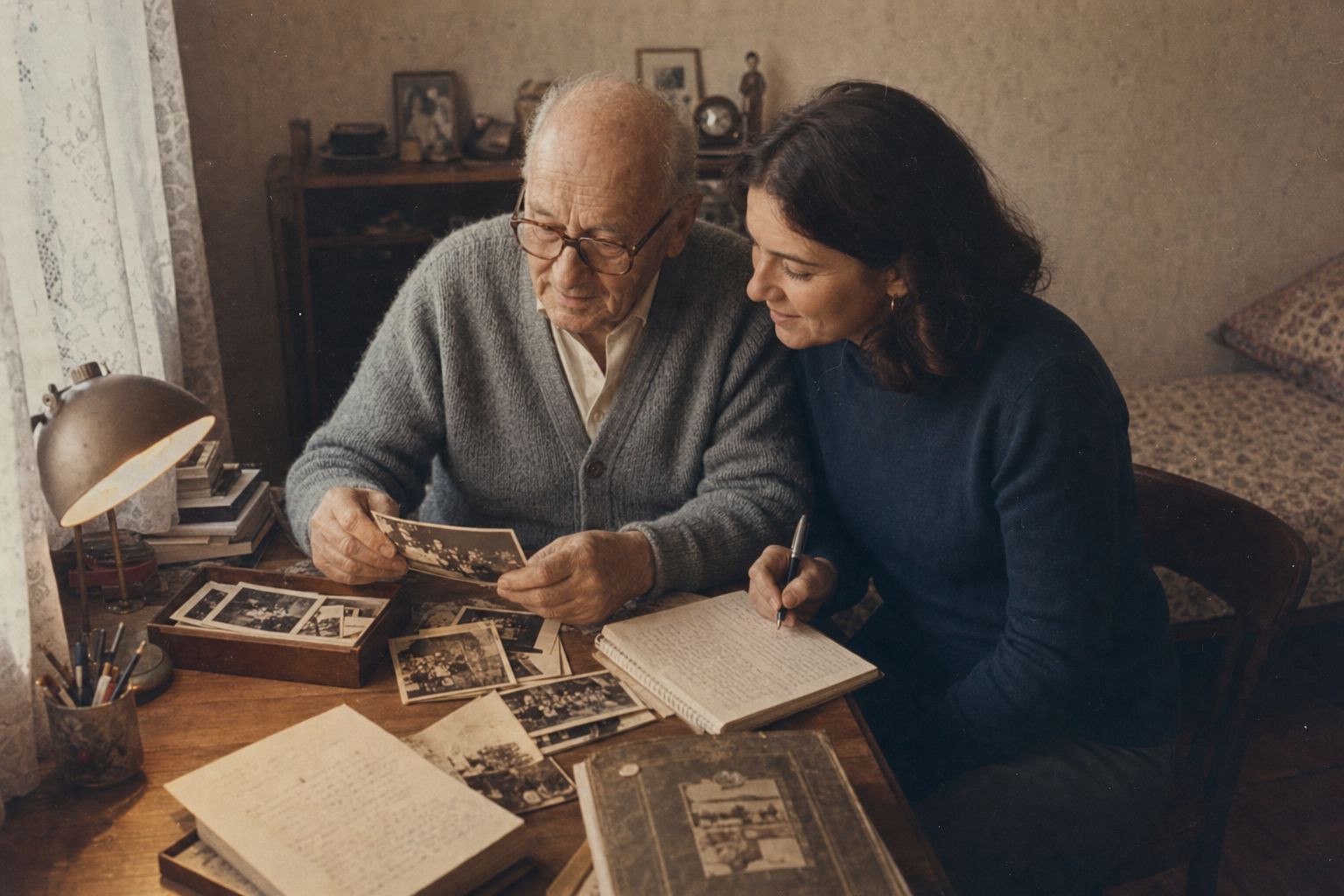
In every family, there is a voice that knows. A grandmother who remembers the village before the road, a father who knew the factory, an aunt who keeps the names of an entire lineage in her head. As long as this voice speaks, everything seems secure. The day it falls silent, we suddenly realize the extent of what has just disappeared.
The memory of our elders is a fragile thing. It is not preserved in photo albums, which show without telling, nor in objects, which are passed down without explanation. It lives in stories, and stories need a medium to endure over time.
Writing so as not to forget: the formula seems simple. Yet it engages something profound, touching on psychology, family ties, and our collective relationship with the past.
What the memory of our elders truly contains
We sometimes imagine that the memories of elderly people are limited to a few picturesque anecdotes, good for recounting at family meals. The reality is far richer. An eighty-year life spans entire worlds: ways of working, loving, eating, facing trials that exist nowhere else but in that memory.
Historians know this well: official archives tell of events, rarely of experience. How did one live through winter without central heating? What did one feel upon receiving a letter after months of waiting? How did one cope with grief, a war, a rural exodus? Only witnesses can tell, with their words, their silences, their tiny details that make the past inhabitable.
Each life story is thus a unique document. When it dies out without having been collected, no library in the world can reconstitute it.
Why writing protects better than shared memory
"We will remember, we will tell each other." This is the promise that all families make, and it is the one least kept. Oral memory deforms with each transmission: dates slip, names get mixed up, circumstances become impoverished. After two generations, often a single phrase, a rough family legend remains, sometimes nothing at all.
Writing works differently. It records the witness's own version, in their language, with their nuances. It can be reread twenty years later, rediscovered by a grandchild who has become an adult, transmitted intact to generations yet unborn. Writing your biography or that of a loved one is like sheltering memory from time, as one would put a treasure in a safe place.
Geriatric psychologists have also highlighted the value of reminiscence, the activity of voluntarily revisiting one's memories. Telling one's life story helps the elderly person connect the periods of their existence, find coherence in them, and feel recognized for what they have lived through. Thus, the act of writing benefits the storyteller first, even before benefiting those who will read.
A legacy that enlightens those who remain
Collecting family memory also transforms those who receive it. Knowing where one comes from, knowing the migrations, the trades, the choices and renunciations of one's ancestors, gives roots and depth to the present. Studies on intergenerational transmission converge on this point: children who know their family history have a stronger identity foundation to face their own storms.
There's a simple reason for this. A family narrative always contains difficult passages followed by reconstructions. Reading that one's great-grandfather lost everything then started over, that one's grandmother raised four children alone, instills a quiet but tenacious conviction: one can fall and get back up. It's a lesson that no theory can replace.
Material inheritance is shared and diluted. Narrative inheritance, however, multiplies: each reader receives its entirety.
How to take the plunge when writing seems difficult
There remains the obstacle that everyone knows. Our elders protest that they "don't know how to write," that their life "isn't interesting," that they wouldn't know where to start. These objections deserve to be heard, then overcome, because they are based on a misunderstanding: no one is asking them for a literary work, only a sincere testimony.
The simplest way is to start small. A question asked during a visit, a memory noted after a phone call, an old photograph commented on together. Memory works by associations: one detail awakens ten others, and the story builds up gradually, without a pre-established plan.
It is precisely to support this journey that we designed Elefantia. The application guides the person with questions, collects their memories at their own pace, orally and in writing, and helps shape them into a printed book. Those who prefer human support can work with a biographer. The essential remains unchanged: the voice that tells the story remains that of the elder, in its truth and uniqueness.
The right time to start is almost always now
It must be said without dramatizing: the memory of our elders has an expiration date. Health, lucidity, and the desire to tell stories have their seasons, and many families express the same regret, that of having waited one year too long. The questions that were not asked then remain unanswered, definitively.
Conversely, undertaking this work during the person's lifetime creates moments of rare quality. Memory sessions bring generations closer, reveal episodes no one suspected, and sometimes mend old misunderstandings. The final book matters a lot; the shared journey to achieve it matters at least as much.
So, instead of postponing this project to calmer days, start with a modest gesture: ask your mother, your grandfather, your long-time neighbor, to tell you a specific memory. Write it down. You have just laid the first stone of a lasting memory. Future generations, those who will bear your name without having known your faces, will be silently grateful to you.
Share:
Family memories: a heritage for all of society
Gift for Grandparents: Offering a Life Story