

Objects wear out, gadgets go out of style, gift cards are forgotten. A life story, however, stands the test of time: it can be read, re-read, passed down, and gains value as the years go by.
This is the promise of this unique gift: to give loved ones, or to receive from them, a book that tells a life story, your own or that of a loved one. A gift unlike any other, because it contains a person.
The remaining question is why this gift touches us so deeply, and how to go about offering it.
Why a life story touches more than any object
The most beautiful gifts are those that say "I know you" and "you matter to me." A life story says both at once, with rare intensity. Giving a grandmother's biography to her grandchildren is telling them that this story is also theirs. Giving a father the opportunity to write his own is telling him that his life deserves a book.
Those who study the psychology of giving often note that the value of a gift lies less in its price than in the time and attention it contains. A life story, however, concentrates hours of conversations, research, and writing. The recipient immediately feels this.
And then there is the singular emotion of discovering oneself within the pages: rediscovering the voice of a loved one, scenes thought lost, faces no longer remembered.
Offering a life story can take two paths
The first path involves writing the story of a loved one for the family. You gather the memories of a parent or grandparent through conversations and interviews, then turn them into a book that everyone will receive. The gift then doubles as another, invisible present: the hours spent together revisiting the past.
The second path involves offering a loved one the opportunity to write their own story: biographical support, a framework, benevolent assistance. Many elders silently dream of telling their life story but don't dare to begin. Offering them this helping hand legitimizes their desire and makes it possible.
In both cases, the final recipient extends beyond the person who unwraps the package: it is the entire family, including future generations, who inherit the story.
A family legacy that speaks to future generations
A life story transmits what objects and photographs leave unsaid: reasons, emotions, context. Why the family left their region, what winters were like back then, how one felt on a wedding day or a departure.
For subsequent generations, these pages become roots. Knowing family history, its overcome trials and new beginnings, helps younger people find their place and nourishes what psychologists call narrative identity: the feeling of being a chapter in a story larger than oneself.
This intangible heritage has a precious peculiarity: it is shared without being divided. Each copy of the book carries the entire legacy, and each reading brings it to life anew.
A gift prepared with heart and a little method
A life story needs anticipation. Allow several months between the first conversations and the printed book: time to gather memories, organize them, write, and review together.
Start with regular interviews, recorded with the consent of your loved one. Use concrete triggers: photo albums, letters, objects, childhood places. Interrogate the senses as much as the facts. The smells of the house, the sounds of the workshop, the songs of an era bring forth memories that general questions leave dormant.
Then comes the writing, the most daunting step. This is where we at Elefantia support families: our application helps to structure memories and write the life story step by step, and our biographers take over for those who prefer to delegate the writing, right up to the printed book ready to be gifted.
The day the book changes hands
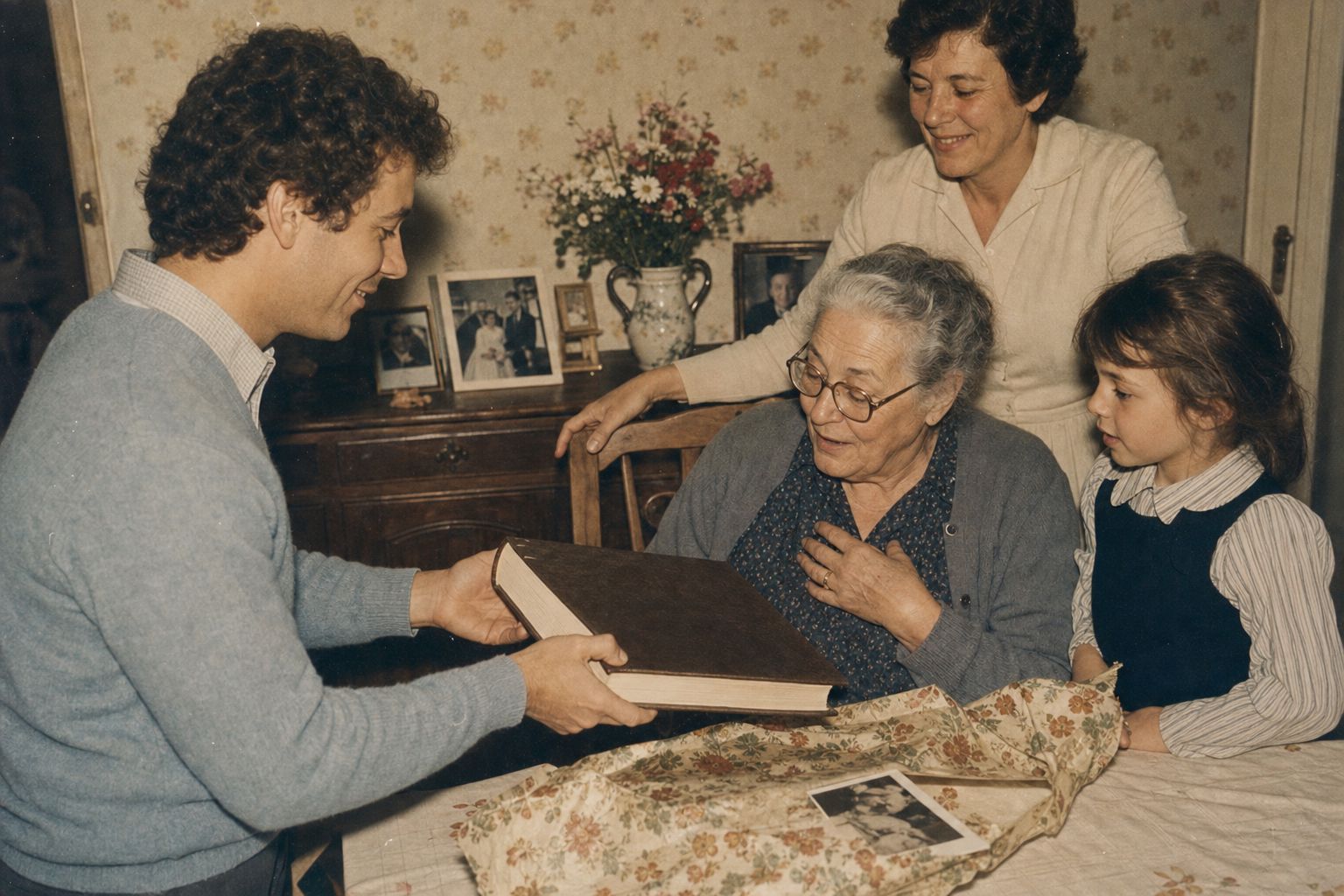
Almost everyone who has experienced this moment describes it in the same way. The package opens, the title appears, silence falls. The elder leafs through their own life, the children lean over their shoulder, someone reads a passage aloud, there is laughter, and tears are wiped away.
The book then finds its place in every home, and its role truly begins: answering children's questions, reading on nostalgic evenings, the family's memory finally placed somewhere.
Such a gift has a lasting impact. Years later, it continues to bring people together, explain, and sometimes console. Few objects can say as much.
The most precious of gifts is told
We all look for the gift that will make a lasting impression, on every occasion. It exists, and it awaits in the memories of your loved ones: a life story to gather, to write, to offer.
So, before the next holidays or the next big birthday, ask yourself the question differently: among your family's stories, which one deserves to become a book? The one who tells it will be grateful, and those who receive it will keep it for life.

Share:
Memories of our elders: writing so as not to forget
Writing the biography of a loved one: a monthly ritual