

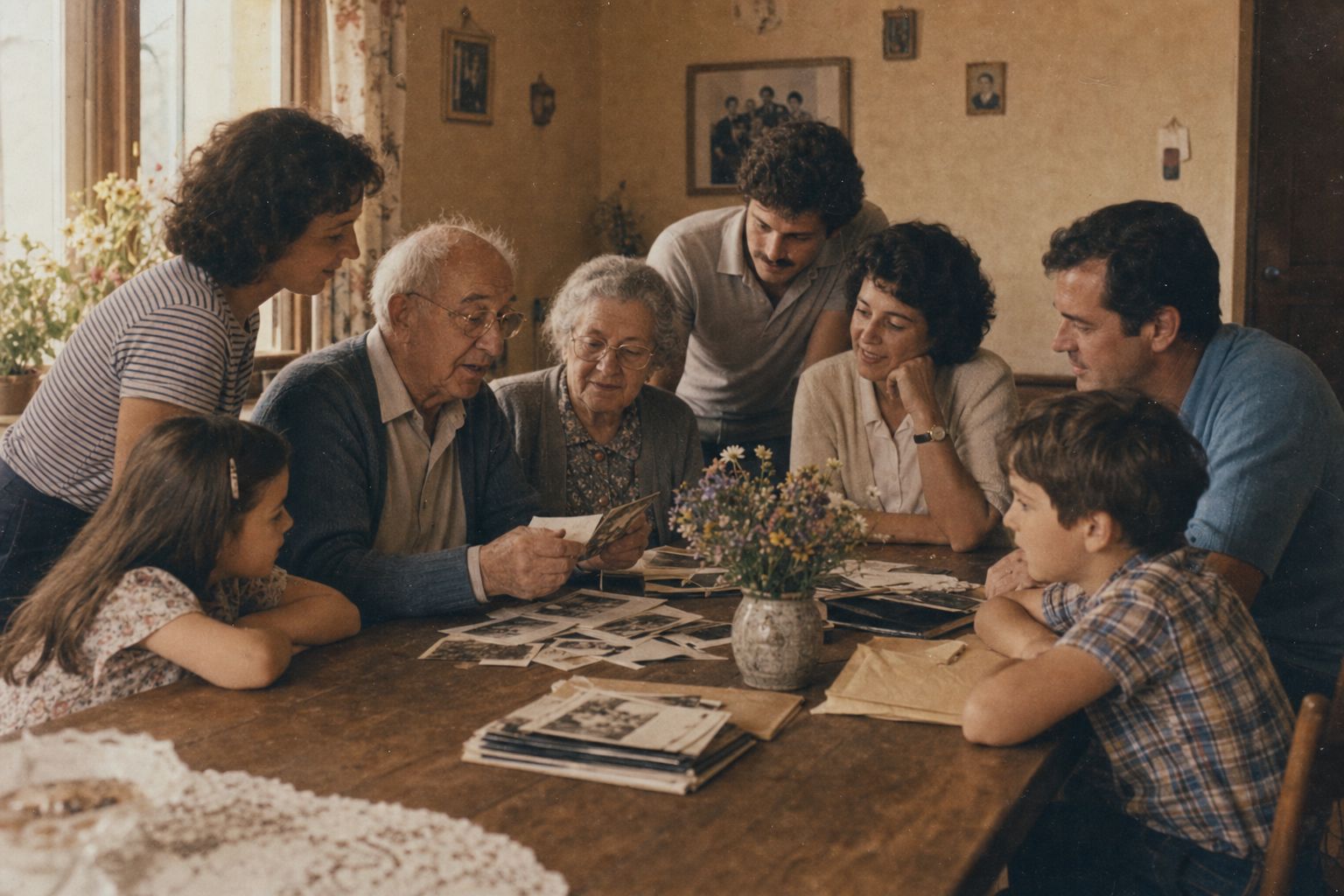
When someone recounts their life, one might think it's an intimate act, reserved for close family and friends. This is true, yet incomplete. Each preserved narrative adds a piece to a much larger structure: the memory of an entire society.
The preservation of family memories extends far beyond the living room where old albums are leafed through. It nourishes collective history, strengthens cohesion between generations, and transmits benchmarks that communities need to understand themselves.
This text aims to take a broader view: what does a society gain, concretely, when its families write and preserve their stories?
Grand history is also built with family memories
Textbooks tell of treaties, revolutions, inventions. They struggle to convey the texture of daily life: what a working-class family ate in 1950, how a child was welcomed, how a farm endured a bad year. This kind of history, historians seek in testimonies, correspondence, diaries, all that ordinary lives have left written.
This is why researchers place such value on life stories. A single testimony illuminates a trajectory; thousands of testimonies outline the major changes of an era, the rural exodus, the entry of women into the labor market, migrations, the transformation of trades. Sociology has even made the biographical method a full-fledged research tool, precisely because individual journeys reveal collective movements.
Every family biography written today will become an archive tomorrow. Modest in appearance, precious in reality.
Common benchmarks that strengthen social ties
A society is held together by its institutions, but also by something more discreet: the feeling of belonging to a continuum. Family narratives play an irreplaceable role here. They remind us that previous generations experienced crises, shortages, and reconstructions, and that they found ways to move forward.
This temporal depth acts as a counterweight to ambient immediacy. At a time when information fades within hours, the recounting of an entire life reintroduces long-term perspective, patience, and nuance. It shows that choices have consequences over decades and that values are forged over time.
Family memories also foster a country's cultural diversity. Stories of immigration, regional traditions, languages, and whispered know-how: all this constitutes an intangible heritage that diminishes as soon as a generation disappears without being heard. Preserving these narratives means preserving the plurality of memories that make a culture vibrant.
What transmission changes between generations
Societal impact also plays out at the family level. Gathering the memories of an elder creates a special relationship: the one who tells feels useful and recognized, the one who listens discovers a person behind the grandparent role. Gerontology has well described the benefits of reminiscence for older people, who find a sense of coherence and dignity in recounting their life journey.
For younger generations, knowing their family history nourishes the construction of identity. Knowing where their ancestors came from, what obstacles they overcame, what beliefs guided them, provides an anchor that helps navigate their own uncertainties. Multiply this effect by thousands of families, and you get a society where generations talk more and understand each other better.
"A family that tells its story is a family that connects." Behind this simple phrase lies a social health issue: the fight against the isolation of elders often begins with a conversation where someone sincerely asks, "tell me."
Writing these memories before they fade
These narratives still need to be recorded somewhere. Oral memory, however heartwarming, quickly deteriorates: details fade, versions diverge, then silence sets in. Writing, on the other hand, spans decades. A family book is placed in a library, lent out, reread at every stage of life, passed down to children born long after its author.
The main obstacle remains taking action. Many elders doubt their legitimacy or their writing skills, many families postpone the project. This is the blockage we strive to overcome with Elefantia: an application that guides everyone, question after question, to tell their story at their own pace, with the discreet support of artificial intelligence and, for those who wish, the assistance of a biographer. At the end of the journey, a real, printed book that takes its place in the family heritage.
The tool matters less than the act: whether it's a handwritten notebook, a recording, or a complete biography, the essential thing is that memory leaves the sole territory of remembrance to join that of documented traces.
A collective heritage that begins at your table
We protect cathedrals, national archives, works of art. It would be consistent to give the same care to the memories of the people around us, for they constitute, put together, the human face of our common history.
The good news is that this immense undertaking requires no decree. It begins in a kitchen, on a Sunday, when someone dares to ask their mother or grandfather a question and takes the trouble to write down the answer. It continues when this testimony becomes a narrative, then a book, then a family reference consulted on special occasions.
Every family that writes its history enriches the heritage of all. Yours, too, holds memories that no one else can ever tell. Recording them today is to offer future generations a little more than dates and names: a living memory from which they can draw meaning long after us.

Share:
Caregivers: sharing a loved one's life memories
Memories of our elders: writing so as not to forget