

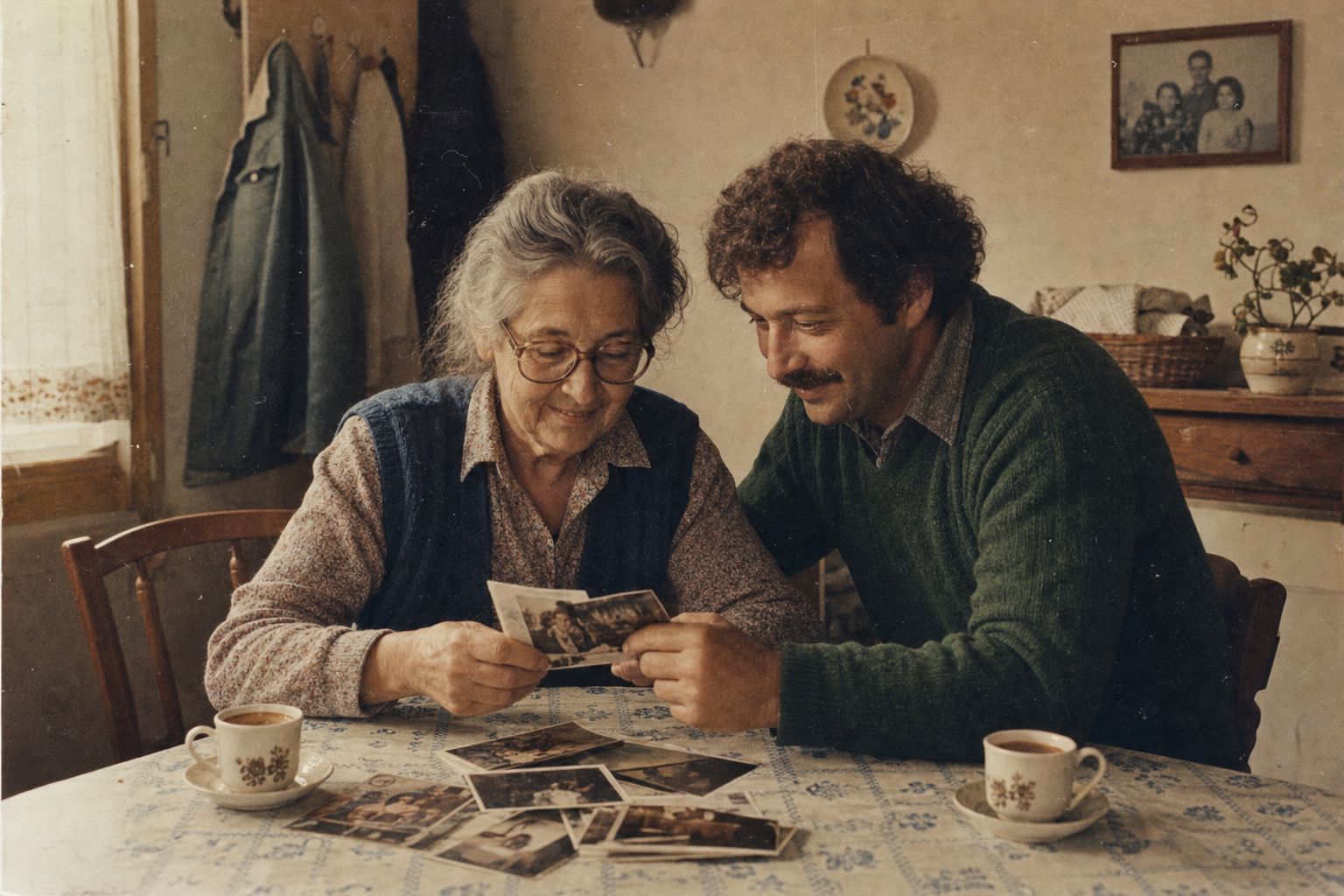
"My life is uninteresting. I haven't done anything extraordinary." This is the first, almost systematic, objection heard whenever the subject of writing one's memoirs comes up. This feeling of having led a run-of-the-mill, ordinary, classic life, in short, stops thousands of people from telling their story.
Let's take this objection seriously, because it deserves more than polite encouragement. Where does it come from? What does it say about our relationship to storytelling? And above all, what is it really worth when we look closely?
A strange Greek letter that became a value judgment
Let's start with the word itself. Lambda is the eleventh letter of the Greek alphabet. Slang from elite schools, which later entered common language, turned it into a pejorative term to describe the ordinary, as opposed to the prestigious first letters: alphas, betas.
Behind this vocabulary lies an elitist philosophy that deserves to be challenged. It would have us believe that there are first-rate lives, worthy of light, and a mass of interchangeable lives, doomed to shadow and silence. This hierarchy of human lives is archaic, and no one should apply it to themselves.
Before accepting the word "lambda", let's look at the idea it conveys. It doesn't stand up to scrutiny for long.
When it comes to life stories, all voices count equally
Let's go back to basics: we are born equal in dignity. In a democracy, all voices count equally when it comes to voting. In biography, the principle applies just as much: all voices, meaning stories this time, deserve the same respect.
Editorial tradition has long reserved biography for "great men" and great women: political figures, athletes, artists, entrepreneurs, endlessly narrated, fictionalized, and celebrated. Meanwhile, so-called normal lives remained untold, as if they were unworthy of memory.
Yet every existence is rigorously unique. No one else has seen the world from your exact place, with your eyes, your era, your attachments, your bifurcations. This singularity is enough to justify a story. Democratizing self-writing is simply giving everyone this fundamental right.
Heroism is also hidden in everyday decisions
We are all the heroes and heroines of our loved ones, the main characters in the novels that our family and friends live through. And there is true greatness of soul in ordinary acts: reconciling after an argument, going to work every morning for forty years, fighting illness, going through a breakup, moving into the unknown, overcoming complexes, building a house or a family, giving life.
None of these acts make headlines. Yet they all build entire lives, and they often require more courage than many publicized exploits. In the eyes of a child, a parent or grandparent is often the true hero of the real world.
The feeling of having had a commonplace life often comes from proximity: we no longer see our own existence, just as we no longer see the landscape outside our window. Those who love you, however, see it very well.
A lambda life contains all the ingredients of a good novel
Ask yourself what makes a good story: engaging characters, twists and turns, suspense, revelations, emotions, identification. Every life is full of them, including yours.
For the niece or friend reading a loved one's biography, the cocktail works wonderfully. The character is inherently engaging, since they are known and loved. The twists and turns, heard once over dinner, are rediscovered with relish, placed back in their context. Suspense and revelations arise from those anecdotes no one knew, slipped in throughout the chapters.
As for identification, it reaches an intensity that no fiction can match: the reader discovers the unique experience of appearing in a book, of encountering familiar places and faces. Smiles and tears are guaranteed, often on the same page. The pleasure frequently surpasses that of yet another story of dragons or mysterious crimes.
Historians are specifically looking for ordinary lives
Another argument completely overturns the objection. Archives abundantly preserve the memory of the powerful: treaties, speeches, official correspondence. What historians desperately lack is the texture of daily life, which only so-called ordinary lives can provide.
This is why they are delighted to discover anonymous diaries, notebooks, and family letters. A whole current of research, microhistory, illuminates great eras through modest existences. Your "lambda life" documents what no textbook will tell: the gestures of a lost trade, the price of things, the songs of a summer, the fear or joy of a specific day.
In a century, the story of an ordinary life today will be an extraordinary document. The ordinary is simply the extraordinary waiting for its time.
The ordinary becomes remarkable as soon as it is told
Finally, this is what we observe at Elefantia, week after week: the people who begin their story by apologizing, "my life is nothing special, you know," are often those whose book moves their family the most. By telling their story, they discover unsuspected consistencies, common threads, forgotten moments of bravery. The narrative reveals what memory took for granted.
And if it still seems to you that your life lacks romance, there is nothing to stop you from adding a little fantasy: a touch of humor, an embellished memory acknowledged as such, why not a dragon as a nod in the last chapter.

Share:
Sharing your life story: a bridge between generations
Why write your biography before it's too late