

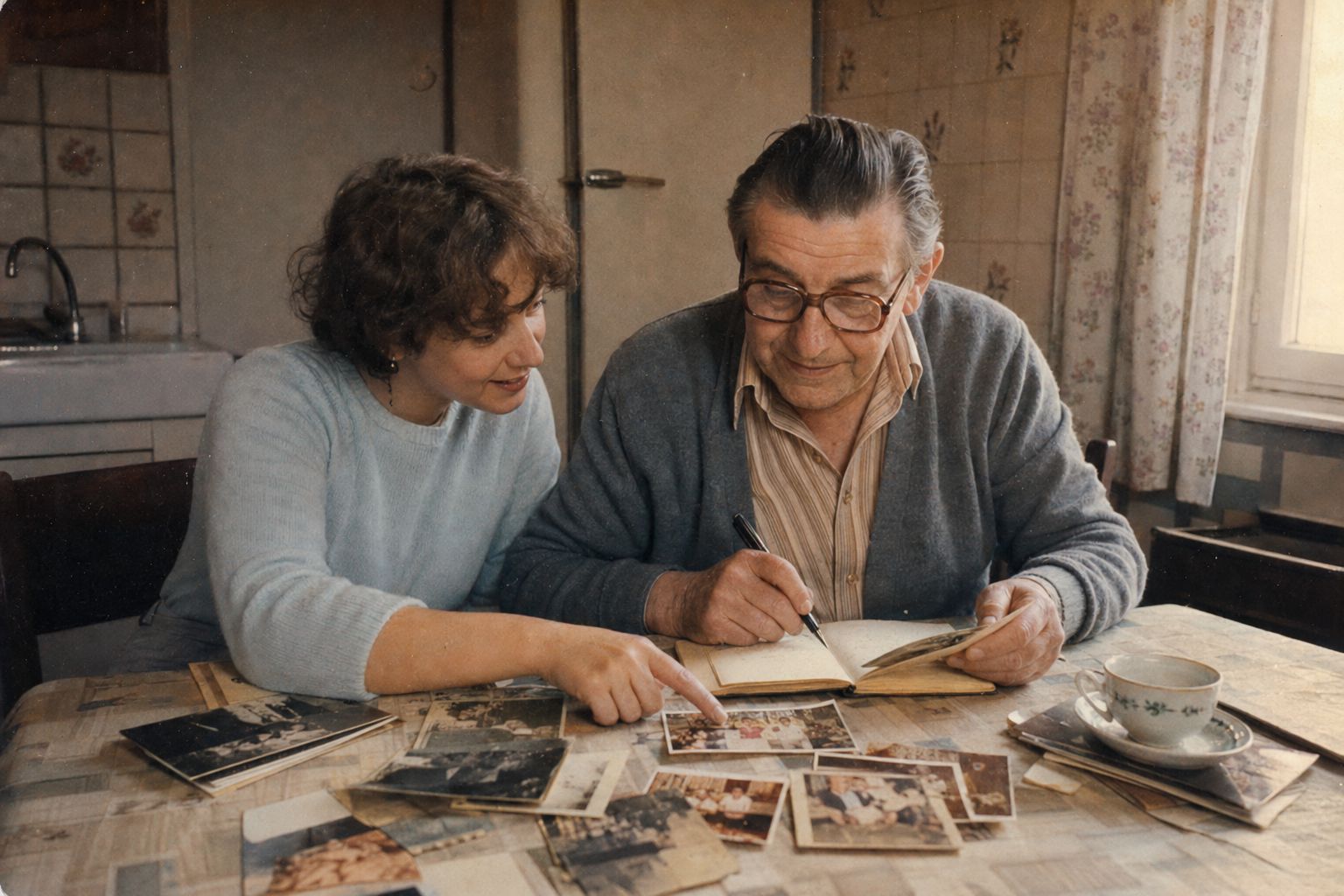
Close your eyes and try to recall a specific Sunday when you were twelve. Nothing, or almost nothing, comes to mind. Now, take a pen and start describing your childhood kitchen: the smell of coffee, the oilcloth, the radio on the sideboard. Memories suddenly flood back.
Anyone can do this experiment. It illustrates the impact of writing on memory, especially valuable for seniors: writing awakens memories as much as it records them, and stimulates the mind as much as it soothes it.
Writing about one's life is thus one of the most comprehensive exercises there is: it engages memory, language, attention, and emotion, while also creating a treasure to pass on.
Writing awakens memories you thought were lost
Autobiographical memory works through associations. One detail calls forth another: a smell evokes a kitchen, the kitchen evokes a face, the face evokes an entire scene. Specialists refer to these triggers that reopen the doors to the past as retrieval cues.
Writing is a powerful machine for producing such cues. Because it forces one to specify places, actions, and circumstances, it pushes memory to search deeper than surface recollection. Many elderly people are surprised to rediscover, page by page, entire episodes they hadn't recalled for decades.
Each writing session thus acts like a walk through an old neighborhood: you set out to revisit one street, and you rediscover ten.
Reminiscence, a recognized practice in gerontology
This work of evoking the past has a name: reminiscence. Professionals working with the elderly have long relied on it, in workshops or individual interviews, to support the psychological balance of older people.
Revisiting one's life in a structured way helps maintain a sense of self-continuity: I am still the same person, the one who grew up, loved, worked, and faced challenges. This rediscovered thread soothes, validates, and gives a place back to the storyteller.
Writing extends and amplifies this benefit. It transforms occasional reminiscence into an ongoing project, with a concrete and joyful goal: to compose, chapter by chapter, the story of an entire life.
Putting words to one's past soothes as much as it stimulates
American psychologist James Pennebaker dedicated his career to expressive writing, a practice that involves putting significant life events, including the most difficult ones, down on paper. His work has opened up an entire field of research on the links between writing and well-being.
The central idea is simple: putting words to an experience helps to organize it, understand it, and give it a place. What remained confused and burdensome becomes a narrative, with a beginning, a development, a meaning.
For a senior, recounting the dark passages of their journey—a bereavement, a war, an exile, a change of fortune—often allows them to view these events differently: as chapters overcome, from which they emerged standing tall.
The impact of writing on memory also comes through meaning
Memory loves what has meaning. Isolated facts are forgotten; stories are remembered. By connecting the episodes of their life into a coherent narrative, the elderly person achieves much more than an exercise in recall: they construct what psychologists call a narrative identity.
This work of plot construction is demanding for the mind, and that's a good thing. Choosing, ordering, formulating, rereading: these are all operations that mobilize attention, planning, and language, functions that are well worth maintaining as the years go by.
Writing thus offers a complete intellectual workout, with a decisive advantage over crossword puzzles: in the end, a book remains.
An exercise that adapts to every hand and every voice
Do you need to be comfortable with a pen or a keyboard to benefit? Fortunately, no. Most of the benefits come from the work of evocation and putting thoughts into words, which can be done just as well by dictating as by writing.
This is the approach we've taken at Elefantia: our application allows you to tell your memories by voice, by answering questions that guide your memory, and then transforms these narratives into polished chapters. Those who prefer a human presence can be accompanied by a biographer throughout the process, right up to the printed book.
The exercise remains the same: summoning memories, organizing them, sharing them. Only the tool adapts, so that age, eyesight, or arthritis never decide in place of desire.
A nurtured memory becomes a shared treasure
Finally, there is something deeply motivating about this practice: it serves two memories at once. That of the senior, engaged, awakened, and maintained session after session. And that of their family, who will one day receive these pages as one receives a part of oneself.
This is perhaps the most beautiful impact of writing on the memory of seniors: it transforms an individual exercise into an act of transmission. Each memory rescued from oblivion becomes one more story in the family heritage, one more root offered to future generations.
We write first to remember. We then discover that we were also writing to be, one day, recounted in turn.

Share:
Aging well: sharing memories and stories
Life story: an emotional legacy to pass on