

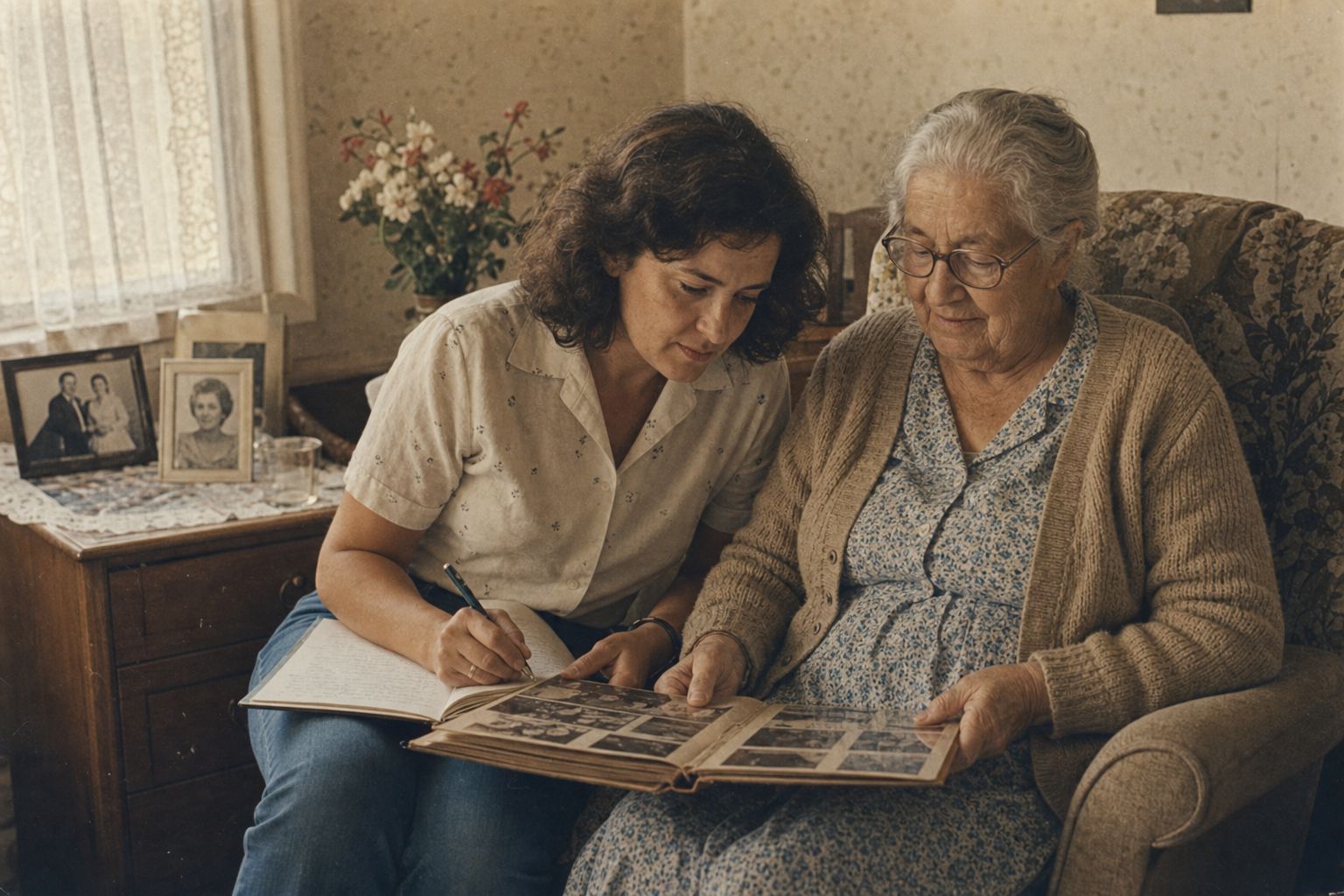
When we think of caregivers, we think of everyday tasks: medical appointments, shopping, sometimes personal hygiene, but especially presence. Millions of people thus support an aging parent, a sick spouse, a fragile loved one, with a devotion that commands respect.
Yet there is a dimension of this role that is rarely discussed. Caregivers occupy a unique place in the transmission of life memories. They are there, day after day, alongside a memory that no one else interacts with so closely. They hear the recurring stories, the names from long ago, the regrets whispered between silences.
This proximity entrusts them, without them having asked for it, with a gentle responsibility: that of being facilitators. And this role, far from adding to their burden, can become one of the most illuminating aspects of caregiving.
Why caregivers are at the forefront of memory transmission
A memory is not delivered on demand. It emerges in trust, at the turn of a familiar gesture: a soup that reminds one of a mother's, a song on the radio, a photograph found in a drawer. Yet trust and regularity are precisely what the caregiver builds over the course of visits.
Many seniors hesitate to talk about themselves. They fear boring others, deem their lives "too ordinary," or dread reliving sorrows. Faced with a stranger, they remain silent; faced with someone who knows and respects them, they open up. The family or professional caregiver benefits from this rare position: they can gather what the person would tell no one else, at the moment they are ready to say it.
Finally, there is a question of timing. The caregiver often accompanies the person in the last season of their full lucidity. What they do not gather now may never be gathered. This awareness of time gives their listening a special value.
Listening to life stories also benefits the storyteller
Encouraging an elder to evoke their past goes far beyond pleasant conversation. Gerontology has long been interested in reminiscence, a practice that involves revisiting one's memories in a structured way. It is associated with improved morale, a strengthened sense of identity, and greater serenity when looking back on one's life.
For a dependent person whose autonomy is diminishing, telling stories becomes an area where they excel again. They know things the caregiver doesn't; they become the one who teaches the other. This discreet reversal restores a dignity that illness or age sometimes damages.
These moments also transform the helping relationship itself. Between two care tasks, the story opens a parenthesis where people meet as equals, around a story. Many caregivers confide that these conversations are among their most precious memories, those that give meaning to difficult days.
How to elicit memories without forcing speech
No need to be a biographer or psychologist. A few simple attitudes are enough. The first is to ask open and concrete questions: "What was your childhood home like?", "What did you eat on Sundays?", "How did you meet Dad?". Specific questions awaken sensory memory much better than general requests.
The second attitude lies in respecting the pace. A painful memory that surfaces deserves to be welcomed without insistence; the person will return to it if they wish. Listening matters more than collecting: someone who feels listened to for themselves, and not interrogated for a file, provides infinitely more vivid accounts.
There remains the third step, often neglected: keeping a record. A notebook where anecdotes are written down after the visit, a recording made with the person's consent, photos captioned together. Without written records, the most beautiful confidences end up joining the oblivion they had momentarily vanquished.
Transforming these fragments into a true family legacy
There comes a time when notes accumulate and it becomes clear: these memories deserve a book. An ordered, bound life story that children and grandchildren can read, offer, and pass on in turn. This transition from fragment to book seems intimidating, especially for an already very busy caregiver.
This is where tools designed for this purpose can lighten the load. With Elefantia, the caregiver can install the application with their loved one and let them answer, orally or in writing, questions that guide reminiscence. Artificial intelligence helps structure and format, without ever betraying the person's voice, and our biographers take over when the family prefers human support. At the end of the journey, scattered memories become a printed biography, an object that the whole family embraces.
The caregiver no longer has to bear their loved one's memory alone: it rests in a book, available to all, for a long time.
A gift that will outlast the caregiving
Daily assistance ends one day, and what remains is what one has managed to preserve. Families who have taken the time to gather their elder's memories all say it: this book becomes a companion in grief, then a link between generations, consulted at births, weddings, at moments when one seeks their roots.
If you are currently supporting a parent or loved one, you hold a discreet power: that of making a voice last. The next time you visit them, ask a question about their childhood, and truly listen. You will see their gaze change. The transmission of life memories begins exactly there, in that offered attention, and it will quietly make you the link through which a story will have continued to live.

Share:
Life Story: Reconciling with Your Past
Family memories: a heritage for all of society