

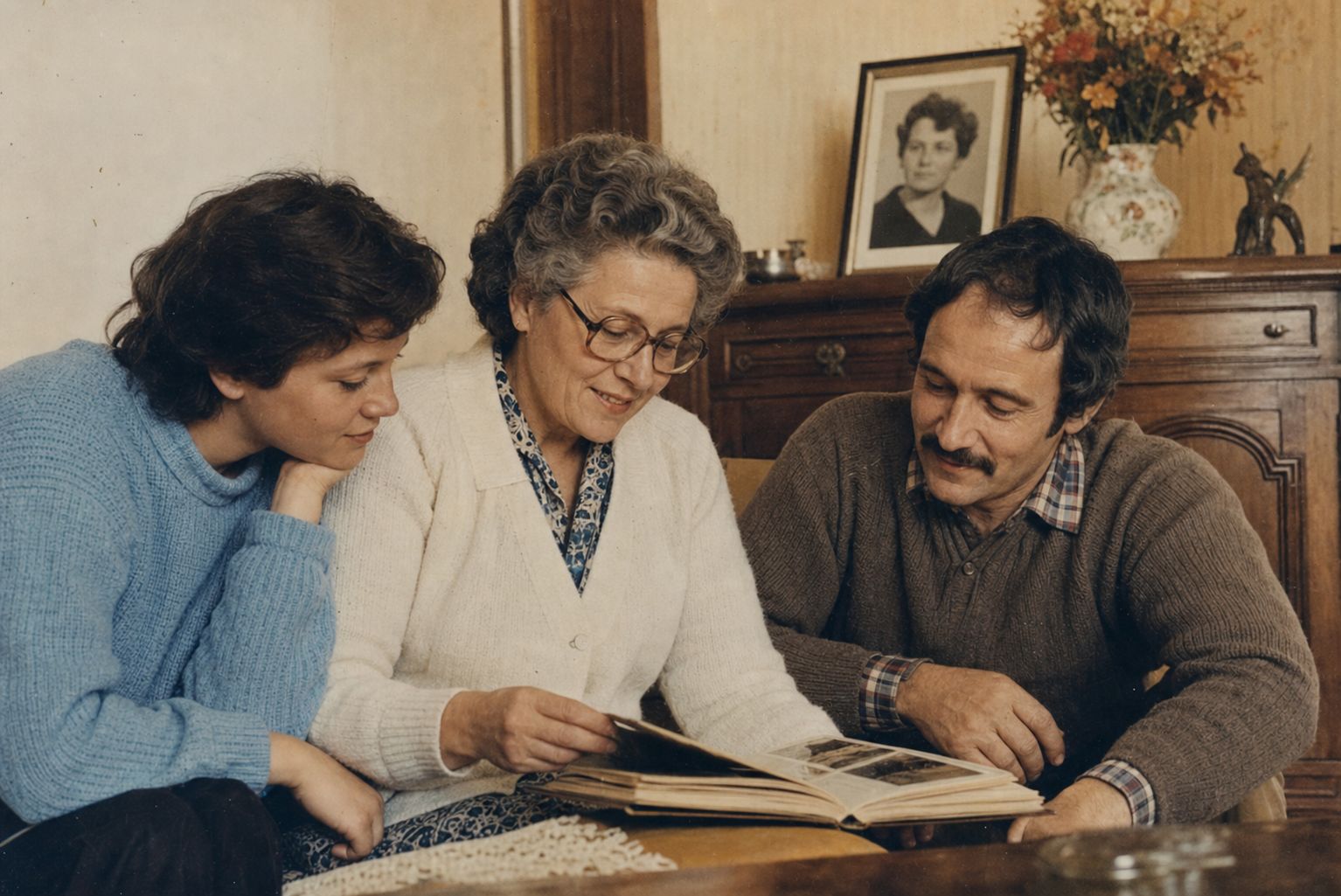
After the funeral, when the house returns to silence, many families seek ways to honor their deceased loved ones other than with flowers and marble. And a thought strikes them: so many things were never asked. How did grandfather experience the war? Where did that Italian branch really come from? Why did Aunt Jeanne leave her village overnight?
Losing a loved one also means seeing memories, anecdotes, and entire parts of family history fade away. Faced with this void, an answer exists, ancient and still vibrant: writing their stories, recording what they lived, said, and passed on.
This tribute requires few resources. It requires memory, listening, and a few pages.
What truly disappears when a voice fades
Photographs preserve faces, civil records preserve dates. What fades is everything else: the way of telling stories, favorite expressions, the recipe never written down, the detail that made everyone at the table laugh. The memory of loved ones keeps these treasures for a while, then the outlines blur.
Family history enthusiasts observe it: beyond two generations, without written records, almost everything is lost. Grandchildren retain fragments, great-grandchildren a name on a family tree.
Writing is stopping this erosion. Each recorded anecdote becomes a fixed point that time can no longer carry away, a landmark offered to all who will one day seek to find the deceased person.
The posthumous biography, a tribute that transcends time
Writing the life of a deceased person is a very ancient tradition: eulogies, memorial books, family memorials. The posthumous biography is its intimate heir. It gathers a person's journey, their era, their choices, their struggles, and offers them to those who will come.
Such a book changes the status of memory. The deceased person ceases to be just an absence: they become a living character again, with a childhood, dreams, funny quirks. Future generations will be able to meet them, almost converse with them.
For the family, the object also matters. A book sits on a shelf, is lent out, given for a birth or a marriage. It gently materializes the presence of the one who is missed.
Writing the stories of our deceased loved ones helps us through grief
The work of memory is also a work of consolation. Psychologists who study expressive writing, following James Pennebaker, have shown that putting painful events into words helps integrate them. Telling the life of a deceased loved one allows happy memories to be brought forth, to give form to sorrow, to express what could not have been said before.
Many bereaved people describe writing as an extended dialogue. During the time of writing, the relationship continues: one searches for the right words for the other, one sometimes understands them better than they had been understood during their lifetime.
The sorrow remains, of course. But it finds a place to settle, and that place brings peace.
Gathering memories, an adventure that brings the living closer
Writing the life of a deceased person is rarely a solitary endeavor. You have to interview siblings, cousins, childhood friends, flip through albums, reread letters. Everyone holds a piece of the story, and often a piece that others are unaware of.
These conversations are beneficial. They allow the family to talk about the deceased, to laugh at their quirks, to cry together without embarrassment. Around the story in the making, bonds tighten, sometimes between branches that had drifted apart for years.
The final book then bears the mark of everyone: a collective tribute, woven from intertwined memories, to which each contributor will remain attached as to a common work.
Where to start this tribute story
No need to wait to know "everything": no life story is exhaustive. One can start with a simple chronology—birth, youth, encounters, profession—or with a more personal angle: beloved places, repeated phrases, a foundational episode.
Documents guide memory: photographs, notebooks, correspondence, objects. Each calls for a question, and each question calls for a story. Write first without worrying about style, in fragments, as memories come. Coherence will come later, when assembling everything.
At Elefantia, we support these projects with our application and with our biographers, who help collect testimonials from loved ones and compose a printed book in memory of the deceased. Many families discover that this undertaking, begun in sadness, ends in gratitude.
What if we didn't wait for their passing to listen?
The most beautiful lesson from these posthumous biographies can be summed up in a sentence their authors often repeat: "I wish I had asked them all these questions while they were alive."
So let's not wait any longer. The stories of our parents and grandparents can be collected today, with their voices, their specific details, their bursts of laughter. The most precious tribute perhaps begins this Sunday, over coffee, with a sincere question.
Honoring our dead and listening to our living comes from the same gesture: recognizing that every life deserves to be told, and that a transmitted story is worth all the marble.

Share:
Family stories: better understanding our past
Dictating your life story: freeing your voice without writing