

Every January brings its share of promises: run more, eat better, cut down on screen time. What if, this year, you chose a different kind of resolution: to write your story?
Take twelve months to put your memories, your journey, what you want to pass on, down on paper. A resolution that requires neither deprivation nor performance, and that leaves behind a book.
The idea can be daunting. "My life is nothing extraordinary," one often thinks. This article aims to address precisely that objection: every existence, when carefully observed, reveals surprisingly rich material.
Why this resolution endures where others fail
Classic resolutions are based on constraint: depriving oneself, forcing oneself, correcting oneself. Motivation quickly wanes because the effort long precedes the reward.
Writing one's story works the other way around. Gratification comes from the very first lines: a memory rediscovered, an era resurfacing, an episode finally understood. Psychologists speak of intrinsic motivation to describe these activities that carry their own reward, and self-writing is clearly one of them.
Added to this is flexibility. A missed session ruins nothing: memories wait, the project resumes where it left off. Where an interrupted diet brings guilt, an interrupted narrative simply reopens on the next page.
Writing your story feels good from the first pages
Personal writing has effects that research has explored since the 1980s, notably through the work of psychologist James Pennebaker on expressive writing. Putting into words the significant events of one's life, including the most difficult, helps to organize them, give them meaning, and lighten their burden.
Writing your life story is also an inventory of your strengths. You rediscover obstacles overcome, choices made, loyalties kept. Many people who embark on this journey find a coherence and courage in their own path that they hadn't attributed to themselves.
Finally, the exercise offers a rare space: a regular moment of calm, away from solicitations, where you dedicate yourself to what truly matters.
Twelve months to write your biography, chapter by chapter
A year provides an ideal framework. January can open with childhood: home, school, games, significant figures. Spring welcomes youth, studies, first impulses. Summer lends itself to major turning points: encounters, careers, departures. Autumn gathers family life, the joys and trials of adulthood. December, finally, invites reflection: what one has learned, what one wants to pass on.
This breakdown is by no means mandatory; it merely shows that a biography can be tackled in pieces. One chapter per month, a few hours per week, and the mountain becomes a series of hills.
The important thing is regularity. A fixed appointment with oneself, a notebook or an app always within reach, and memory gets to work on its own: memories resurface between sessions, called forth by those just written. Some prefer to follow the seasons rather than the calendar, writing about childhood summers in July and past Christmases in December.
A story that transcends you and waits to be passed on
This resolution will do you good, and it will also do good for those around you. Your children and grandchildren will find in your story what no photo album contains: your perspective, your emotions, your reasons. Family memory gains a document that future generations will consult like a treasure.
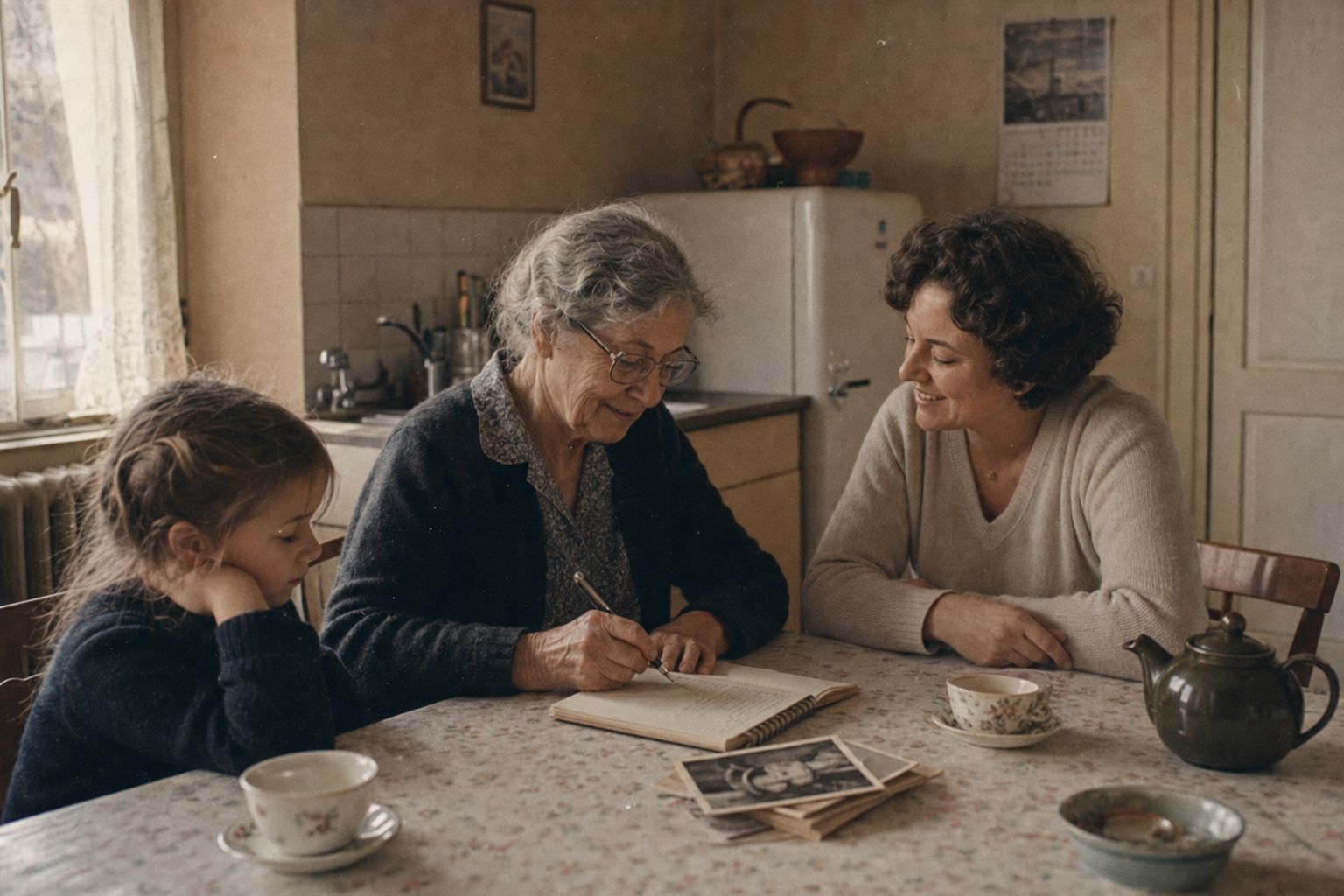
Also consider the inverse version of the project: writing the story of a loved one. Dedicating the year to gathering the memories of a parent or grandparent, month after month, offers the same joy of writing, enriched by conversations you will not forget.
In both cases, the result goes beyond a simple document. A transmitted life story means a family that knows where it comes from.
How to stay the course without getting discouraged
Start small: an anecdote, a page, a specific memory. The breadth will come on its own, because memory is generous to those who regularly solicit it. Set a recurring time, Sunday morning or Tuesday evening, and protect it like an important appointment.
Accept the disorder. Memory delivers its treasures without a plan: write what comes, organization will follow. Also talk about your project with those around you. Loved ones who ask questions become valuable allies, and their reminders keep the flame alive during slow weeks.
At Elefantia, we designed our application to overcome these obstacles one by one: questions that guide memory, a space where memories are organized, and biographers, our Elefantos, to accompany those who prefer to proceed with assistance, right up to the printed book.
In one year, a book that reflects you
Imagine next December. On the table, next to the gifts, a book: your story, or that of a loved one, gathered, written, printed. An object that no one will ever throw away, that will be read in twenty years as it was on the first day.
Resolutions that last are those that build something. This one builds a bridge between what you have lived and those who will follow you. Only the first page is missing, and the best time to write it is today.

Share:
Writing the biography of a loved one: a monthly ritual
Senior isolation: sharing memories as a remedy