

We often reduce aging well to health guidelines: walking, eating a balanced diet, monitoring sleep. These tips are valuable, but they lack an ingredient that aging specialists rank first: the quality of connections with others.
Aging well also means sharing: memories, experience, one's vision of the world. A long life accumulates riches that only ask to circulate, and it is often by offering them that we finally measure their value.
Because a memory kept to oneself slowly fades away. The same memory, told to a grandchild or written in a book, begins a second life.
Aging is becoming rich in stories that no one else possesses
Each year lived deposits its sediment: learned trades, inhabited homes, friendships, instructive mistakes, simple joys. At seventy or eighty, a person carries within them an entire library, of which they are the sole copy.
This wealth has a particularity: it can only be transmitted through sharing. Money is bequeathed by notary, furniture by inheritance; experience, however, requires being told during one's lifetime, in a living exchange.
This is what makes the words of elders so precious, and their silence so costly for families who, too often, realize too late all that they would have wanted to ask.
Aging well involves the feeling of still mattering
Aging psychologists insist on a fundamental need at any age: to feel useful and recognized. Psychoanalyst Erik Erikson spoke of "generativity" to describe this concern for transmitting to subsequent generations, which he considered one of the great tasks of maturity.
Telling one's story exactly meets this need. The one who shares their experience takes on an active role: witness to an era, conveyor of values, source of advice proven by life. Their past becomes a resource for the present of others.
Many seniors say it after the fact: by telling their story, they felt that everything they had been through was finally serving someone.
Sharing one's experience nurtures self-esteem and social connection
Sharing memories has very concrete effects on morale. Revisiting one's journey, including its difficulties, allows one to recognize one's own endurance and discreet successes. Self-esteem is thereby consolidated, at an age when it is sometimes challenged by widowhood or loss of autonomy.
The benefit is also relational. A story told invites questions, laughter, and confidences in return. Around a life story, visits change texture: each becomes an opportunity to continue a conversation started the previous time.
Faced with isolation, which threatens so many elders, sharing memories is one of the gentlest remedies available. It requires neither material nor organization: a visit, a call, a sincere question suffice. And unlike many activities offered to seniors, it draws on what they already possess in abundance, an entire lifetime of material to tell.
Sharing goes both ways, between generations
Receiving a story is also an art. Grandchildren who question their grandparents offer them something invaluable: genuine attention, proof that their words have value.
In return, they receive benchmarks that neither school nor screens provide: family memory, the meaning of places and names, examples of resilience drawn from their own lineage. Transmission thus weaves a double-threaded link, where everyone gives and receives simultaneously.
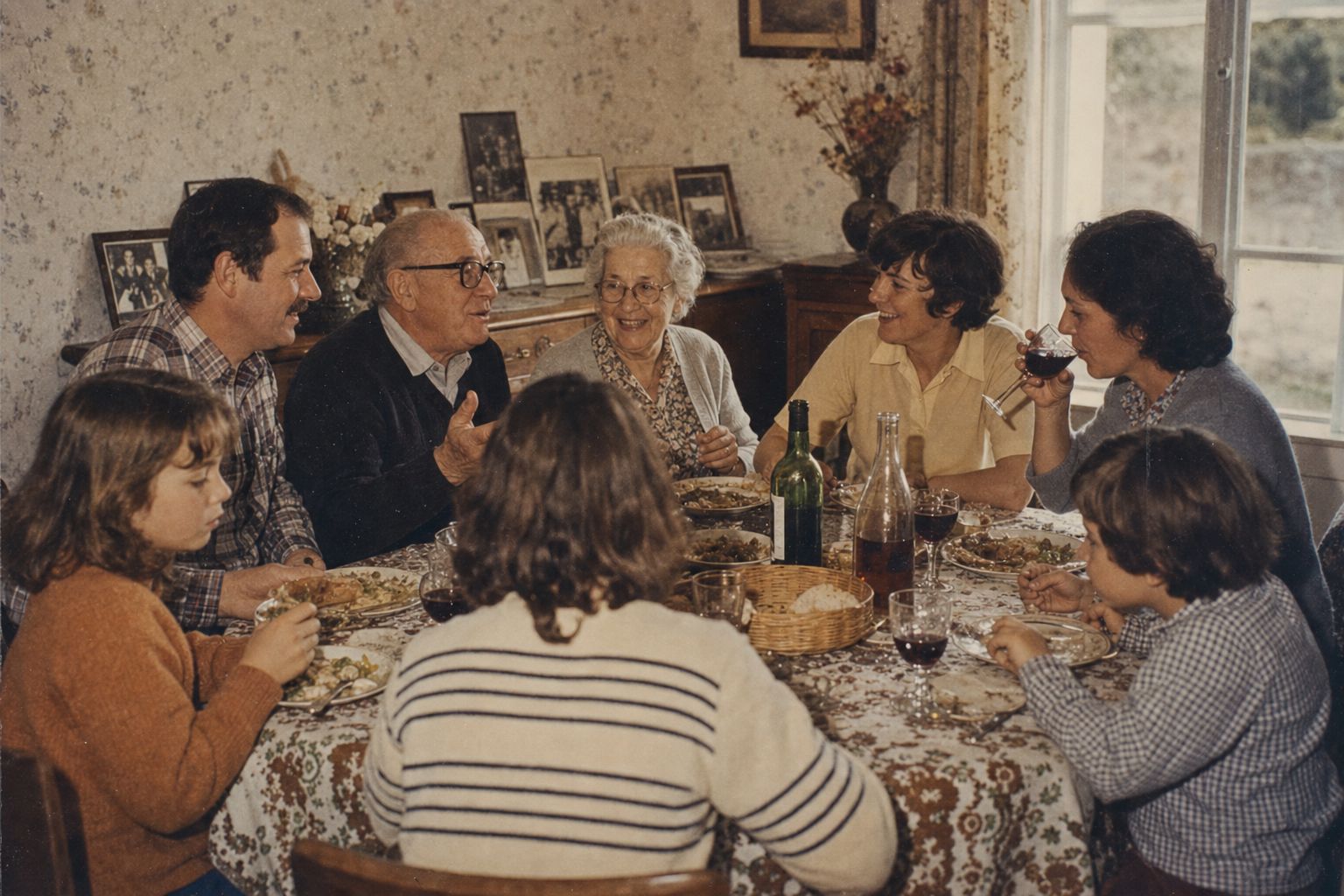
Family meals have always confirmed this: a sincere question, "tell us what it was like," is all it takes for three generations to hang on the same story. These moments are often among the memories that grandchildren will cherish the longest.
From told memory to transmitted book, there remains a simple step to take
For sharing to last beyond conversations, it still needs to be given a form. This is where the written life story takes on its full meaning: it captures what has been told and offers it to those who have not heard it, including future generations.
This transition to writing has become considerably simpler. With the Elefantia application, anyone can tell their memories by answering questions, in writing or by voice, and watch them gradually take the form of a book. Our biographers accompany those who prefer to journey together.
The book then becomes the natural extension of sharing: a conversation with loved ones that continues, page after page, far beyond the family living room.
What is shared never grows old
There is a form of wisdom in understanding that our memories are especially valuable for what they bring to others. A told ordeal can save a grandson a detour; a described happiness can remind a busy daughter of what truly matters in life.
Aging well, ultimately, is continuing to give. And among all that a long existence allows one to offer, the story one carries is the only gift that grows by being shared: it comforts the one who tells it, enlightens the one who listens to it, and enriches those who will read it later.
So tell it. Around a table, in a letter, in a book. Someone, somewhere in time, is already waiting to hear from you.

Share:
Write a book without being a writer: tell your story
Writing and Memory in Seniors: Concrete Benefits