

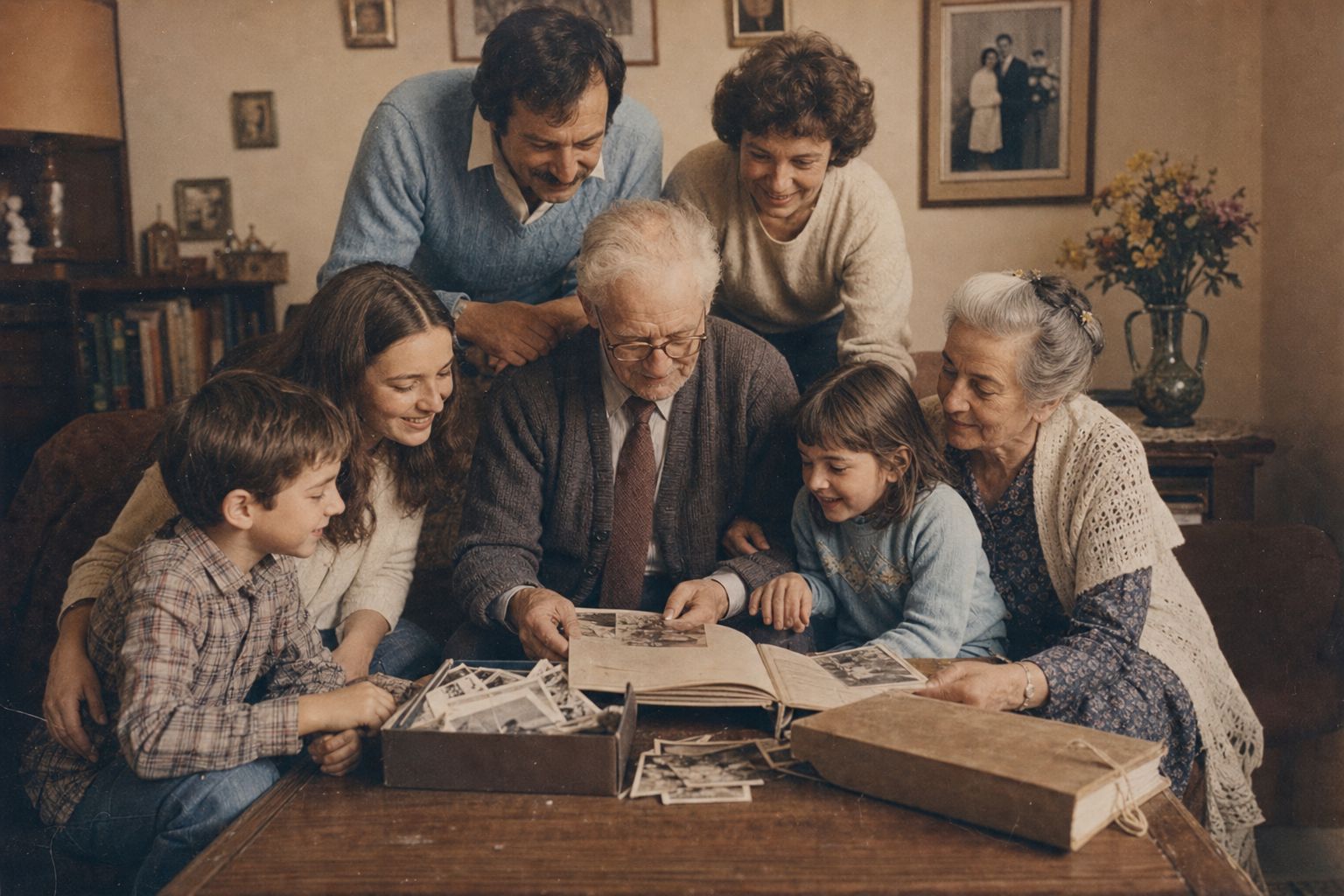
Every family possesses a treasure not listed in any notarized deed: memories, stories, life lessons from their elders. This intangible family heritage is poorly transmitted in a hurried world, where stories told on a festive evening fade away for lack of being collected. It is to address this fragility that Elefantia was created.
Our conviction is simple: everyone has a story that deserves a book, and everyone should be able to tell it, regardless of their age or writing proficiency. Here's how we concretely support families, and why this journey often changes much more than expected.
The most precious family heritage isn't kept in a safe
We bequeath houses, furniture, jewelry. We more rarely bequeath memory, even though it forms the core of what unites a family. How did your grandparents meet? What did they go through, hope for, rebuild? What values guided their choices?
Family sociologists observe that knowing one's family history nurtures a sense of identity and belonging, in children and adults alike. A transmitted story provides roots, benchmarks, sometimes explanations that soothe old questions.
However, this memory relies on a few people, often elderly. Without a voluntary effort to collect it, it disappears with them, taking with it answers that no one will be able to provide anymore. This observation, repeated in so many families, forms the basis of our work.
An application that transforms speech into a life story
Elefantia is primarily a mobile application, available on iOS and Android. Its principle can be summarized in one sentence: you tell, it helps you structure.
Specifically, the application offers questions that guide the evocation of memories: childhood, places, encounters, life's turning points. You can answer by writing or simply by speaking, as in a conversation. Session after session, memories are organized into chapters, and the life story takes shape, at its own pace, without the anxiety of a blank page. You advance one memory at a time, without a forced order, and the whole is built almost without you noticing.
This method was designed for people who don't feel like "writers," especially for seniors: few manipulations, a conversational logic, the freedom to stop and resume whenever they wish.
Biographers at your side, the Elefantos
Technology isn't always enough, and some stories require a human presence. That's why we've brought together a network of accompanying biographers, whom we call Elefantos.
An Elefanto listens, questions, prompts, helps organize memories, and finds the right tone. Some families call on them to collect the story of an elderly parent who prefers to speak to a person rather than a screen. Others find support in them for addressing delicate chapters: a hardship, a bereavement, a long-hidden part of family history finally told.
Elefantos intervene remotely or in person, occasionally or throughout the project, depending on each family's needs and budget. Their role is never to rewrite a life, but to help it emerge, with the tact of those who know how to listen.
This human support remains a personal choice. Alone with the application, occasionally supported, or accompanied from start to finish: all paths lead to the same book.
Discreet artificial intelligence, serving your voice
Yes, Elefantia uses artificial intelligence. And it's important to state precisely what it does, because nuance matters. AI helps structure: it organizes the narrated memories, suggests questions for deeper exploration, and identifies episodes that might deserve further development.
The writing, however, is entirely yours. The words remain yours, your phrasing, your way of telling, because a life story is only valuable if it carries the voice of the person who lived it. We see AI as a workshop assistant: it prepares, categorizes, illuminates, then steps aside.
This technological discretion explains why people of all ages, including those far removed from digital technology, successfully complete their projects with pleasure.
From a shared memory to a book on the living room table
At the end of the journey, there is an object: a real printed book. This point matters more than one might imagine. A file gets lost in a folder; a book sits on a shelf, is browsed on a Sunday, is lent, given for Christmas, reread by each generation.
Many families tell us about the moment the book arrives: the grandfather who turns it over in his hands for a long time, the grandchildren who discover that "grandpa was twenty," the conversations that resume with renewed vigor around the table. The book concludes the project and reopens the dialogue. It also becomes a rallying point: it is brought out for birthdays, shown to newcomers in the family, sometimes a second volume is added when other memories resurface.
It is this combination—the application, human support, discreet AI, and a printed book—that allows family heritage to be preserved in a lasting and vibrant way.
What if transmission started this Sunday?
Preserving family memory requires neither a grand project nor lengthy preparation. It begins with a question asked of a loved one, a noted memory, a first session in the application, a chat with an Elefanto.
Every story collected today will become, in thirty years, a treasure for readers yet unborn. Generations pass, stories remain, and a family that knows its history moves forward with deeper roots.
And you, which family memory would you like to safeguard first? The table at the next family lunch might be the best place to ask the question.
Share:
Seniors and technology: sharing your stories simply
Writing to heal: the power of words in the face of grief