

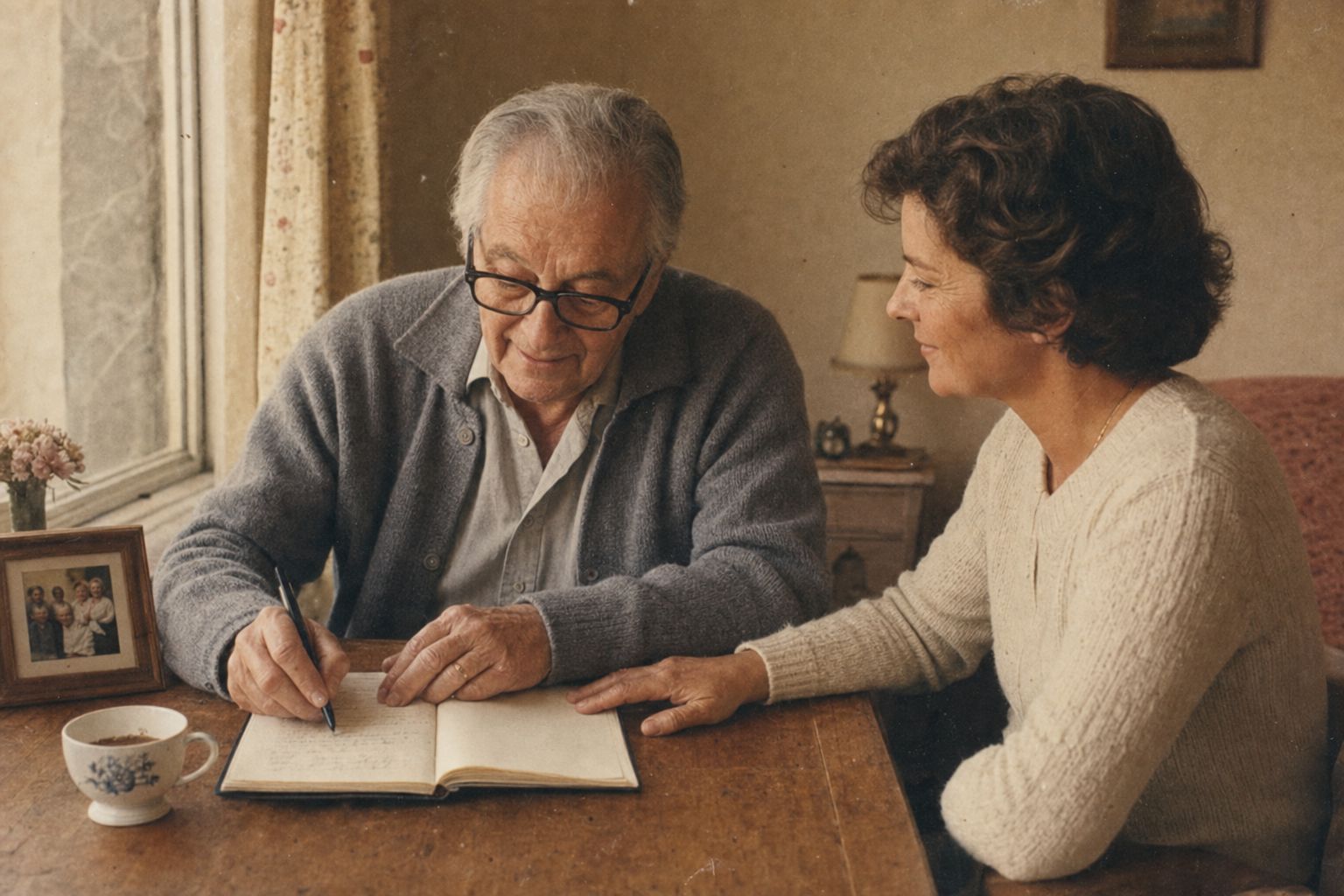
Can words truly heal? The question seems almost naive, as the pain of grief or hardship appears to be beyond the reach of language. And yet, the power of words to heal is among the realities best observed by those who support people in suffering: writing about what one is going through helps one to go through it.
Losing a loved one leaves an immense void. Loved ones, rituals, and time do their work, slowly. However, there is an ancient gesture, accessible to all, that supports this journey: telling a story. Putting into words the departed person, the shared history, what was experienced and what remains.
This gesture has a name when it becomes a project: writing the biography of a loved one. And its effects extend far beyond a simple tribute.
Where the healing power of words comes from
Psychology has long been interested in what writing does for those who suffer. The work of American researcher James Pennebaker on expressive writing has paved the way: regularly writing about painful events, describing both the facts and the emotions felt, improves the well-being of many people.
The explanation largely lies in the structuring. Mute pain loops endlessly, overwhelming, without boundaries. Formulating it forces one to look at it, to name it, to give it a beginning, a development, a possible meaning. Inner chaos becomes a narrative, and a narrative can be kept at a distance, re-read, shared. Naming, ordering, connecting: three simple gestures that regain control over what seemed elusive.
Writing complements care and therapeutic support when needed. It is a discreet ally, available at all hours, who never judges.
Writing the biography of a deceased loved one, a tribute that does good
After a loss, many fear forgetting. The sound of a voice fades, anecdotes blur, dates get mixed up. This fear adds a dull anxiety to the grief itself.
Writing the biography of the deceased person directly addresses this fear. Gathering memories, interviewing siblings, leafing through photos, reconstructing the thread of a life: this work revives shared moments instead of letting them fade away. We rediscover forgotten episodes, we later understand choices, silences, tenderness.
Each written page becomes a bridge between what was and what remains. Those who have undertaken this work often say that they emerged with the feeling of having spent, one last time, a long moment with the loved one.
Narrative transforms pain into living memory
Grief work, psychologists explain, consists of finding a new place for the bond that united us with the deceased person. Narrative is one of the best artisans of this inner shift.
By telling a life story, we stop reducing it to its end. Illness, accident, the last months often occupy the entire memory of the bereaved. Writing reopens the field: childhood, travels, bursts of laughter, battles fought, daily gestures regain their place. The person becomes whole again, in the full depth of their existence.
"By writing about my mother, I found the woman she was before she got sick." This phrase, heard so often in various forms, summarizes what narrative accomplishes: it restores life to its rightful proportion in the face of death.
An emotional legacy for future generations
Writing heals the writer; it also offers something precious to those who will come after. A family biography allows children and grandchildren to know those who preceded them, to understand the origin of a first name, a character trait, a value passed down from generation to generation.
Memories recorded in a book escape the erosion of oral memory. In thirty years, a grandson will be able to read how his great-grandfather met his wife, what he loved, what he overcame. No photo album alone can offer this direct link between generations, because an image shows faces without ever telling lives. The book, however, preserves both: the features and the voices, the facts and the emotions that accompanied them.
Writing to heal and writing to transmit thus come together in the same gesture: entrusting words with the task of carrying what the heart refuses to lose.
Finding words when they don't come easily
One honest difficulty remains: faced with a blank page, many feel helpless, especially in their grief. Where to begin? Should one follow a chronology? Is it permissible to also write about the dark areas, the disagreements, the regrets?
Support can then change everything. At Elefantia, we have designed an application that guides speech through simple questions, and biographers, our Elefantos, accompany those who desire a human presence by their side. You tell your story at your own pace, orally if writing is intimidating, and the narrative takes shape until it becomes a printed book, without anyone else writing what only you can say.
Each story thus put on paper becomes a refuge: you can return to it, reopen it on difficult days, pass it on to your loved ones. So, if you were to tell the story of a loved one, where would you begin? This question deserves to be asked without delay, because answering it already does good.

Share:
Elefantia, the app for preserving your family heritage
Collecting memories from the pre-digital generation