

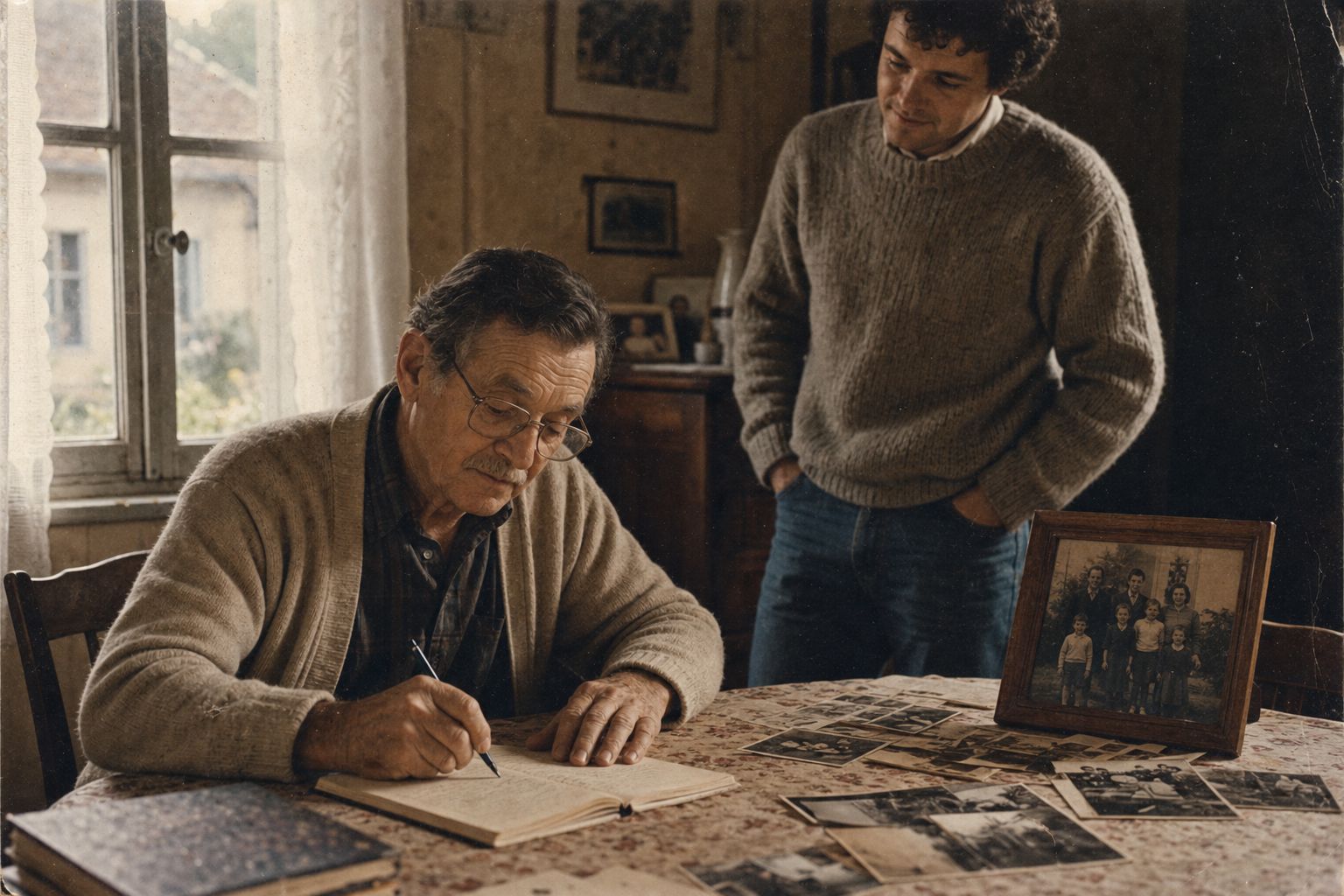
If so many people are passionate about genealogy today, it is because ancestry is intriguing. Behind every name on a family tree lies an entire existence, of which often only a date, a place, a profession scrawled in a register remains. To write to leave a trace is to refuse this reduction: to offer future generations far more than a line in a civil status record.
For life is ephemeral, and we all know it. Faced with this obvious truth, writing remains one of the oldest and surest gestures humanity has invented to make what passes endure.
Imagine reading your ancestor's biography from 1820
Close your eyes for a moment. You hold in your hands the life story of your nineteenth-century ancestor. You would discover a bygone era: carriages, industrial revolutions, monarchical or imperial regimes, non-existent women's rights, lives often brief and harsh.
But you might also recognize family traits already present two hundred years ago. Leon, the great-great-great-grandfather, already quick-tempered in the face of injustice. Mireille, already mischievous in her teenage years in Marseille in 1870. These resemblances, these parallels with the present, would make you smile. Zola, better than anyone, was interested in how characters are passed down through generations, almost scientifically, from branch to branch.
This book, alas, probably doesn't exist. Your ancestors left nothing, convinced that their daily lives would interest no one. This is exactly the mistake we can avoid repeating.
Your daily life will one day become a period document
The distance between science fiction and reality shrinks every year: autonomous cars, artificial intelligence, conversational robots, virtual doubles, immersive games. Much of what artists of the last century imagined already exists.
Let's continue the projection. When cars really fly, when our brains are connected, when summers last for months, many objects of our daily lives will seem like outdated curiosities: the flat screen, cash, paper newspapers, SUVs, perhaps even social networks. Who knows what history will place on the shelf of vanished oddities?
The story of your life, lived across the twentieth and twenty-first centuries, will one day be a goldmine for your great-grandchildren. How people worked, how they loved, how they traveled, what they ate, what made them laugh or tremble: the most mundane details will be the most exotic.
Write to leave a trace that spans centuries
Human existence is terribly short. On a planetary scale, we pass through Earth like ephemeral insects, for a single day. Writing, however, transcends time.
Let's be clear: writing doesn't make anyone eternal, and it would be illusory to believe so. Is Chateaubriand more alive than his sister because we still read his Memoirs from Beyond the Grave? He rests like her beneath the earth, on the islet of Grand Bé, his back to Saint-Malo, facing the sea. For those who believe in the soul, perhaps it survives in the sea spray of Saint-Malo or between the lines of his books.
But whether one is religious, spiritual, agnostic, or atheist, one thing remains certain: his manuscript is still there. It tells us about a man, and it tells us about an era, that of the French Revolution and Napoleon. The text outlives the hand that wrote it. This is the only form of permanence we truly possess.
History is also written with ordinary lives
We sometimes imagine that history is nourished only by the memoirs of ministers and generals. Historians tell a different story: they rejoice in discovering anonymous diaries, family correspondence, account books, ledgers. These modest documents reveal the texture of an era, what official archives superbly ignore.
An entire historiographical current, microhistory, has shown that an ordinary existence, studied closely, can illuminate an entire society. The story of a village schoolteacher, a textile worker, or a mother can sometimes say more about their time than many official discourses.
Writing one's biography or life story is therefore also an archivist's gesture: each of us holds information about our time that no one else will record in our place.
Each life story adds a piece to the great human puzzle
By writing, we transmit to future generations the pieces of an immense puzzle: the story of Humanity. It doesn't matter if your piece is in the center or on the periphery, if it is multicolored or monochrome. Without it, the picture remains incomplete.
The thread of each life weaves the tapestry of History. Whatever the place where it unfolds, whatever the events it traverses, it will one day allow someone, historian, descendant, or simply curious, to better understand the past.
This idea changes the way we look at our own existence. Writing ceases to be an intimate exercise and becomes a discrete and real contribution to collective memory.
The trace is left now, with one's own words and at one's own pace
There remains the act of writing, often postponed year after year. This is precisely the purpose of Elefantia: to allow everyone to write their life story by simply recounting their memories, alone or accompanied by a biographer, up to the printed book that will take its place in the family library, then in that of subsequent generations.
Life is ephemeral; the written trace is much less so. In a century, your words will be the voice of a vanished era, read by eyes that may resemble yours.
So ask yourself the question that opens all stories: what would you want people to still know about you, and your world, in a hundred years?
Share:
Why write your biography before it's too late
Life story: more than just a biography